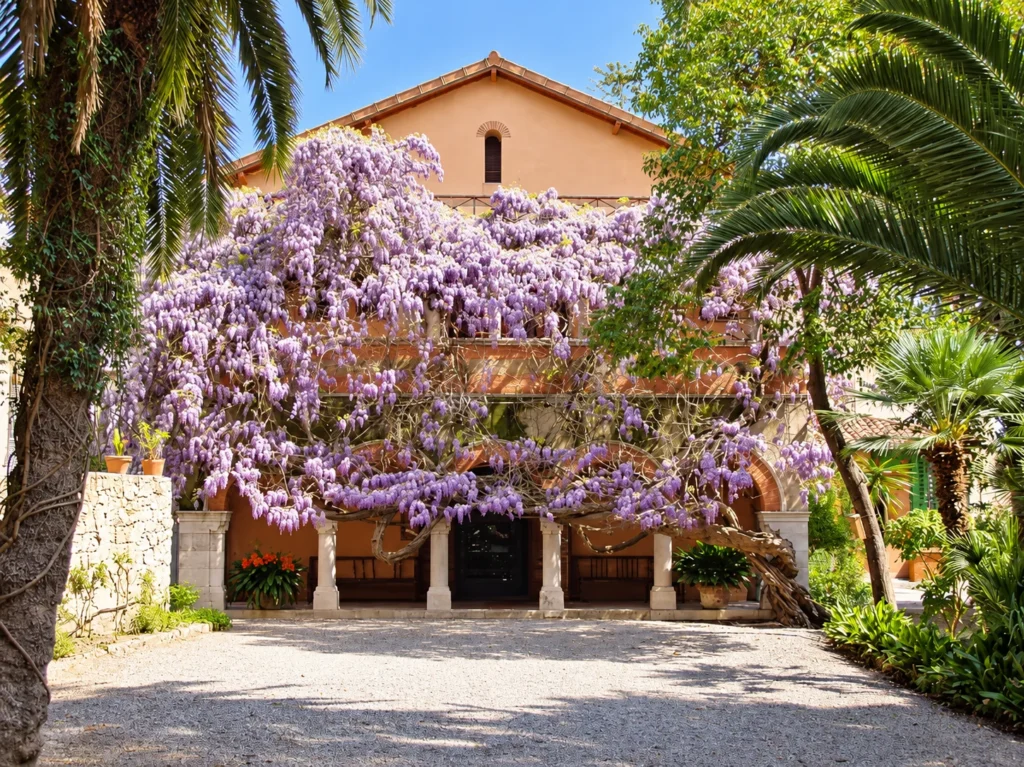


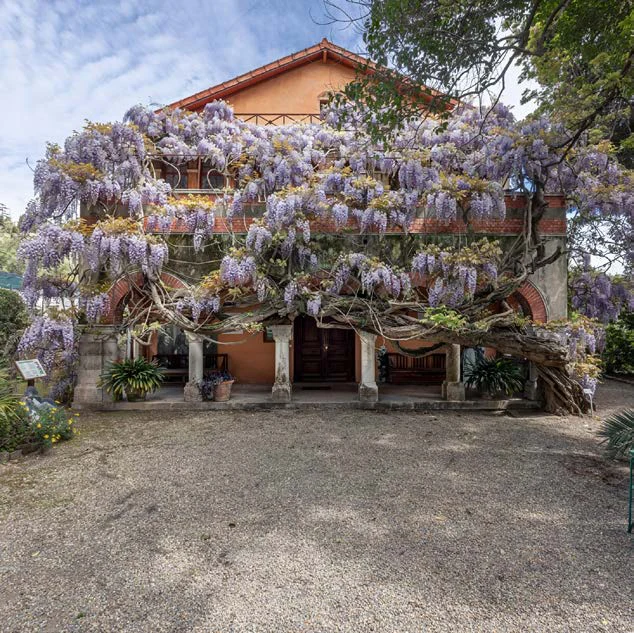
Every spring the façade of the Museo Bicknell is dressed in purple. The wisteria that wraps around the small entrance portico lets hundreds of fragrant clusters fall between the columns, and for a few weeks the building Clarence Bicknell created seems to vanish behind a veil of flowers. Through the arches you glimpse the quiet atmosphere of a place created for study and the contemplation of nature.
It is not just a pretty plant to photograph: it is one of the seven trees in Bordighera listed in Italy’s official register of monumental trees, and the first on the town’s list, with the code 01.
The Bicknell wisteria
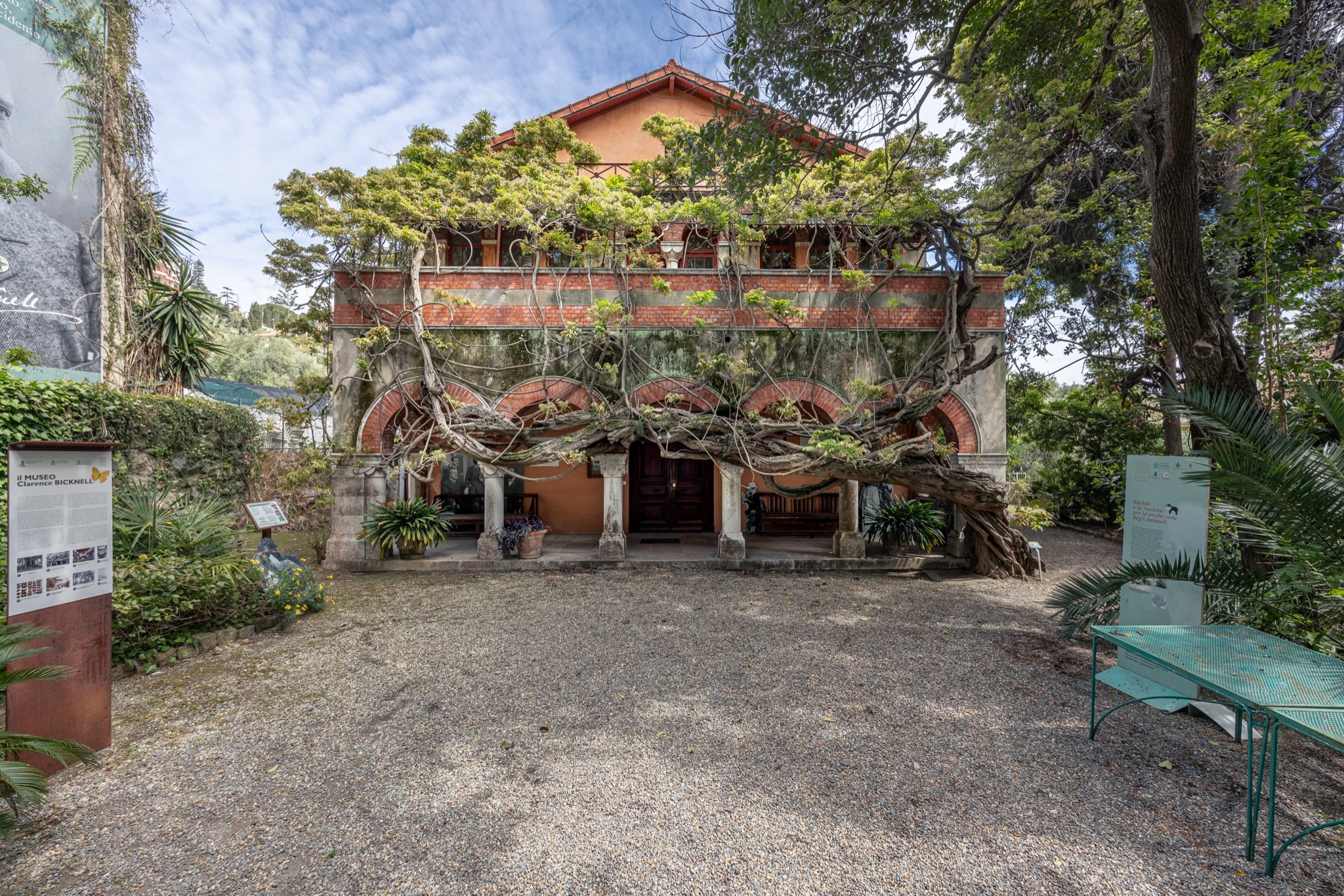
The museum was built in 1888 by Clarence Bicknell, the English clergyman with a passion for botany, archaeology and painting who chose Bordighera as his home. The design is attributed to the English architect Clarence Tait: a rectangular building with an entrance portico supported by classical-style columns. It is on that portico that the wisteria has grown, until it covered the façade and became, together with the Moreton Bay figs at the gate, the symbol of the museum.
For a naturalist like Bicknell, who painted flowers and collected plants between the Riviera and the Maritime Alps, a garden like this was the ideal setting for his collections. Today the museum is the home of the Istituto Internazionale di Studi Liguri, and the complex is protected by the Soprintendenza.
A climber from China
The museum’s wisteria is a Wisteria sinensis, Chinese wisteria, native to central and southern China. It was unknown in Europe until 1816, when agents of the East India Company sent cuttings to England; from there it spread through the European gardens of the 19th century, including those the English created on the Riviera.
It is a woody, long-lived plant that climbs by twining its stems anticlockwise around its supports. Over the decades the stem thickens and twists like a rope, and the Bicknell specimen, with a circumference of 160 centimetres, has taken on the sculptural shape that has made it a monument.
When it flowers
Chinese wisteria flowers in spring, before the leaves have fully opened: the clusters, 15–20 centimetres long, all open at once and have a faint scent of grapes. The exact timing changes from year to year depending on the season: if you want to see it in bloom, check shortly before you set off.
After the flowers come the leaves, green and glossy, which shade the portico in summer; in autumn velvety pods hang from the plant. Take care with children: all parts of the plant, especially the seeds and pods, are toxic if swallowed.
Why it is monumental
The wisteria is listed in the national register of monumental trees for its age and size and for its shape and bearing: it is rare to see a climber of these proportions, with such a massive stem, grown in harmony with the architecture that supports it. It was recognised by the Liguria Region in 2015 and entered the first national register approved by the ministerial decree of 2017.
Botanical profile
- Scientific name: Wisteria sinensis (Sims) Sweet
- Common name: Chinese wisteria
- Origin: China
- Stem circumference at 1.30 m: 160 cm
- Height: 7.5 m
- Monumental criteria: age and/or size, shape and bearing
- Register code: 01/A984/IM/07
How to see it
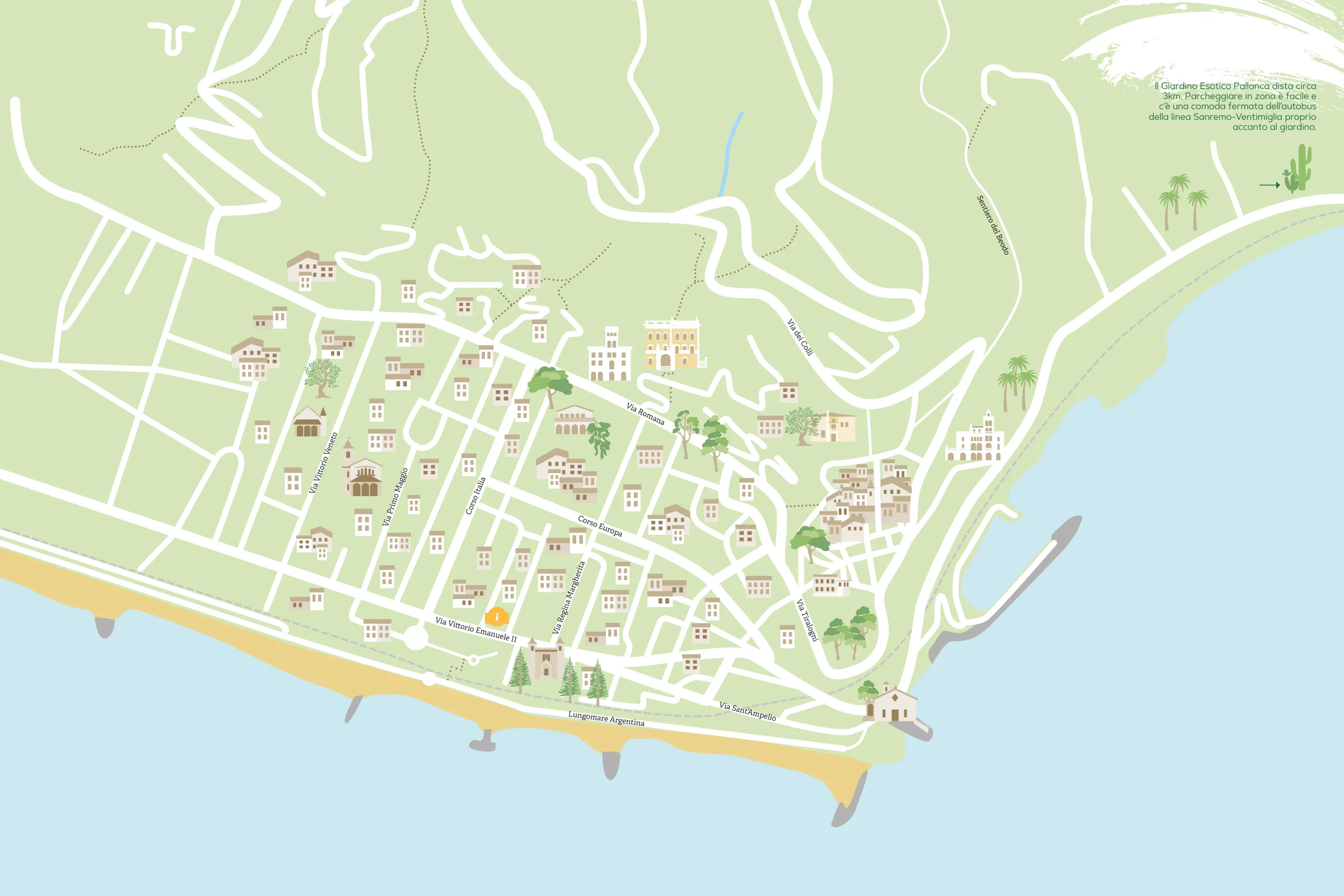
The wisteria is on the façade of the Museo Bicknell, at Via Romana 39, a few minutes’ walk from the centre and the station. It cannot be seen from the street: to admire it you have to enter the museum garden, open during the Museo Bicknell’s opening hours, so it makes sense to combine it with a visit to the collections and the monumental fig trees at the entrance.
Nearby
At the museum entrance you are greeted by the Moreton Bay figs at the Museo Bicknell, also monumental trees. Along the Via Romana you will find the Biblioteca Civica Internazionale, with another century-old wisteria on its façade, and a little further on Villa Etelinda and Villa Regina Margherita. For a day among extraordinary plants, follow the itinerary Gardens and monumental trees, with the Canary Island pine and the araucarias of the Lungomare Argentina.
Frequently asked questions
When does the wisteria at the Museo Bicknell flower?
In spring, before the leaves open. The exact weeks depend on the season and change from year to year.
Can you see it from the street?
The wisteria is in the museum garden and cannot be seen from the street: you can admire it during the Museo Bicknell’s opening hours. For admission and guided tours, see the practical information on this page.
How many monumental trees are there in Bordighera?
Seven. Besides the wisteria: the two fig trees at the Museo Bicknell, the “Scibretta” at Palazzo Garnier, the Canary Island pine in Via Tumiati, the olive trees of the Fondazione Pompeo Mariani and the Norfolk Island pine on the Lungomare Argentina.