

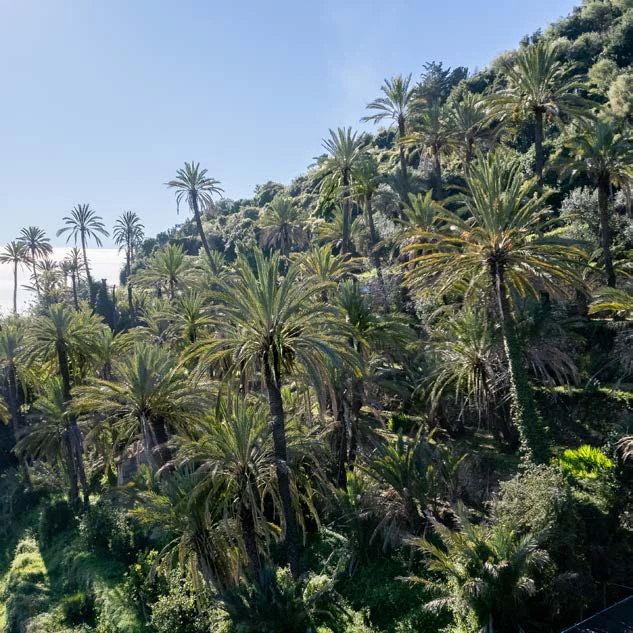
Bordighera is the “city of palms”, and the place where that name was born is the historic palm grove of the Sasso valley, between Arziglia and the hills behind Bordighera Alta. Date palms, Phoenix dactylifera, have grown here for centuries: at a latitude of 43° 47′ it is considered the northernmost date palm grove in Europe, far from the oases where the species grows in the wild.
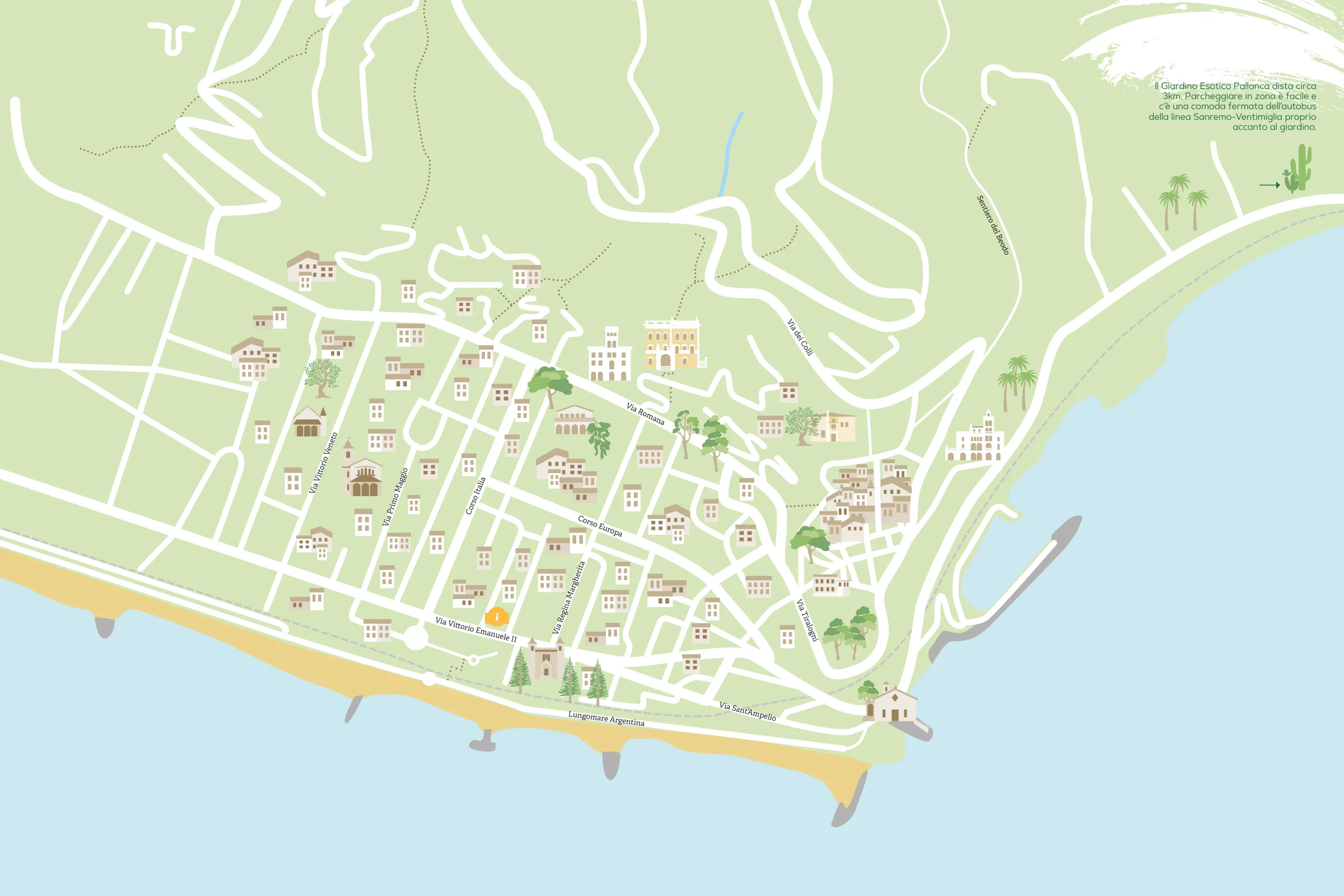
The loveliest way to discover it is on foot, along the Sentiero del Beodo, the old channel that crosses the valley between dry-stone walls, olive trees and palms. For centuries these palms were not ornamental but a livelihood: their leaves were used to make the woven palms for Palm Sunday, sent as far as Rome, and the branches for the Jewish Feast of Tabernacles.
From Sant’Ampelio’s palms to the “Jericho of Europe”
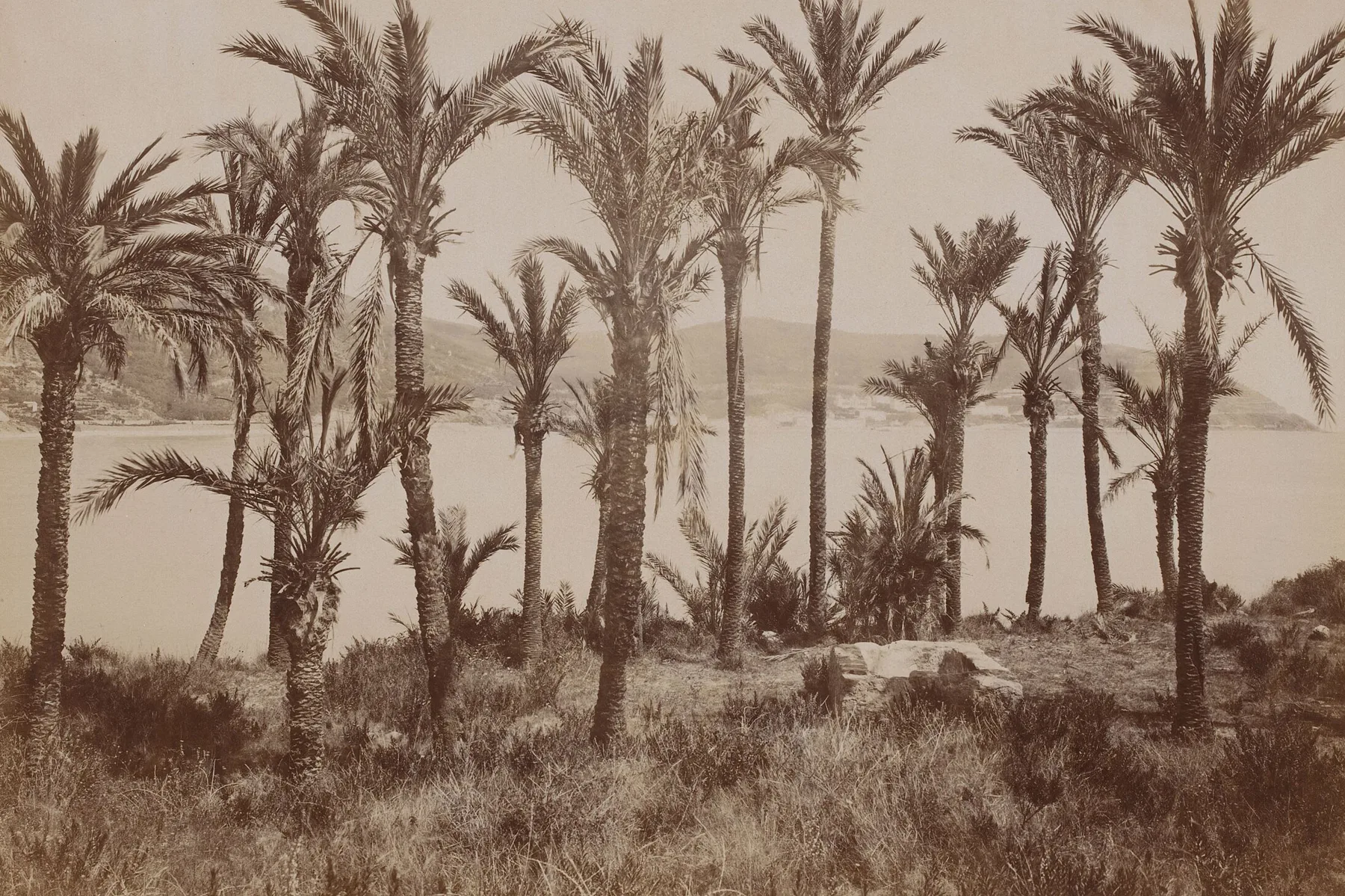
According to legend it was Sant’Ampelio, the hermit from Egypt who lived on the Capo between the 4th and 5th centuries, who brought with him the date stones from which the first palms grew. More likely the palm grove dates from the Middle Ages, when the village was founded. As early as 1453 the historian Flavio Biondo, in his Italia illustrata, described the territory of Sanremo as rich in lemon trees and palms, trees that were very rare in Italy and were blessed and handed out to the people on Palm Sunday.

For centuries whole families of parmurà, the palm growers of Bordighera and Sanremo, lived from this work: they grew and pruned the palms and wove the leaves for Christian and Jewish religious festivals. In the Sasso valley the palms were planted along the edges of the terraces, where they shaded the vegetable gardens, figs, orange trees and pomegranates; water from the Beodo irrigated the terraces.
In the 19th century the palm landscape won over foreign travellers: in Giovanni Ruffini’s 1855 novel Doctor Antonio, the young Englishwoman Lucy, looking at the palms of Bordighera, feels as if she were in Asia Minor, and some called this stretch of the Riviera the “Jericho of Europe”. In the 1870s the German gardener Ludwig Winter settled in Bordighera and began growing new species of palm right in the Sasso valley, where in 1875 he created his gardens. In the 20th century, however, the palms lost their economic value, and mimosas, flowers and asparagus took their place on the terraces.
The painters’ valley

In the 19th century the Sasso valley was one of the favourite destinations of foreign visitors and artists. In 1864 the Bordighera painter Giuseppe Ferdinando Piana frescoed it in the rooms of the Hotel Angst; in 1884 Claude Monet painted it several times, with the palms, olives and citrus trees bathed in light; a few years later the German Hermann Nestel made a large painting of it, now at the Istituto Internazionale di Studi Liguri, whose prints made the valley known throughout Europe. Many views can still be recognised along the itinerary In Monet’s footsteps.
Captain Bresca’s palms
The most famous story linked to Bordighera’s palms dates back to 10 September 1586. In St Peter’s Square in Rome, the obelisk commissioned by Pope Sixtus V was being raised, and absolute silence had been ordered for the operation. When the ropes began to give way under the strain, Captain Benedetto Bresca, a Ligurian sailor, shouted in dialect “Aiga ae corde!”, water on the ropes: once wet, the ropes held and the obelisk was raised. To thank him, according to tradition, the pope granted Bresca and his homeland the privilege of supplying the Vatican with palms for Palm Sunday.
Bordighera and Sanremo both claim Bresca as one of their own. Today the parmureli are taken to the pope by the Famija Sanremasca, while in Bordighera some are working to bring the woven palms of the Beodo palm grove back to the Vatican too.
The white palms and the parmureli
The leaves used for the parmureli are white, and not by chance. Every summer, in the week before the feast of Santa Maria Maddalena, the palm growers climb to the top of the palms and tie the crown tightly, so that the new leaves grow in the dark, without chlorophyll. They are untied in March, a few weeks before Palm Sunday: the leaves, a pale ivory colour, are cut and woven into elaborate shapes. The same palms also supplied the branches for Sukkot, the Jewish Feast of Tabernacles, sent to Jewish communities all over Europe.

The palm grove today
Palms once covered much of Bordighera’s territory, as far as Sanremo; today the historic palm grove is concentrated in the lower part of the Sasso valley, towards the mouth of the stream, between Arziglia, the cemetery and Villa Garnier. The census carried out by the town council in 2003 counted 988 date palms and, in all, almost 1,500 palms of twenty different species, many of them introduced from the 19th century onwards.

Along the Sentiero del Beodo is the Marilena Natta experimental garden, where the ritual of tying and untying the palms is renewed every year. It is looked after by the volunteers of the Cumpagnia d’à Parmura, founded in 2011 to teach the weaving of parmureli and to restore the palm grove. There is no shortage of work: in recent years the red palm weevil, a beetle of Asian origin, has killed a great many palms on the Riviera, especially Canary Island date palms, and has also struck the palm grove.
How to visit the palm grove
The palm grove is not a park with an entrance: it is a farming landscape, largely on private land, that you cross on foot. The easiest route is the Sentiero del Beodo, which starts from Bordighera Alta and within a few minutes, almost on the level, takes you among the palms. To see the lower part of the palm grove you can walk down towards the Sasso stream near the cemetery and continue towards Arziglia, where you will also find the Giardini Winter and Villa Garnier.

Tips for your visit
- When to go: all year round. In March, when the palms are untied, you can see them “open” and the white leaves; the week before Palm Sunday is the time of the parmureli.
- How long you need: an hour for the walk along the Beodo to the Sasso stream and back.
- Respect: the palm grove is largely private property. Stay on the paths and do not cut palm leaves.
- Combine it with: the Sentiero del Beodo, Bordighera Alta and the church of Sant’Ampelio, where, according to legend, it all began.
Frequently asked questions
Where is Bordighera’s palm grove?
In the lower part of the valley of the Sasso stream, between Arziglia and Bordighera Alta. You cross it by walking along the Sentiero del Beodo.
Why is Bordighera the city of palms?
Because date palms have grown here for centuries, in what is considered the northernmost palm grove in Europe. For generations the palms were also a livelihood: their leaves were used for Christian and Jewish religious festivals.
What are parmureli?
They are the woven palms of Palm Sunday, made with the white leaves obtained by tying up the crown of the palms during the summer.
Is it true that Bordighera’s palms go to the Vatican?
According to tradition, Pope Sixtus V granted the privilege to Captain Benedetto Bresca in 1586. Today the parmureli for the pope are prepared by the Famija Sanremasca.
Can you visit it freely?
Yes, from public paths such as the Beodo, free of charge and at any time. The cultivated terraces, however, are private property.