

In brief
Liguria’s curiosities begin with its shape: a thin strip of land squeezed between the mountains and the sea, where for centuries every valley had its own history, its own dialect and its own saints. That is why such a small region holds so many legends and traditions, from the Genoese sailors who claimed the right to complain to the witches of a mountain village, and even a bronze statue on the seabed.
In this collection you will find seventeen stories, arranged by theme. We cover the whole region, but with a special eye on the Ponente, the Riviera dei Fiori on the border with France, and on Bordighera, the city of palms, where many of these stories can still be seen and touched.
A word of warning before we set off: some are documented facts, others are legends handed down by word of mouth. We tell you which each time, because in Liguria history and storytelling often intertwine, just like the palm fronds of Palm Sunday.
Bordighera and its palms: three stories to know
1. Bordighera’s palms in St Peter’s Square
One of Liguria’s most famous traditions was born in Rome, on 10 September 1586. Pope Sixtus V had ordered the Egyptian obelisk that now stands in the centre of St Peter’s Square to be moved, a feat directed by the architect Domenico Fontana with hundreds of men, horses and winches. According to tradition, the pope had imposed absolute silence during the lifting. When the ropes, under the enormous weight, began to give way, a Ligurian sailor, Benedetto Bresca, is said to have shouted in dialect “Aiga ae corde!”, water on the ropes: once wet, the hemp ropes would shrink and hold the load.
Instead of punishing him, so the story goes, the pope rewarded him, granting him and his descendants the privilege of supplying the palms for Palm Sunday in the Vatican. Sanremo and Bordighera have always both claimed Captain Bresca, but the bond between the Riviera’s palms and Rome is real and centuries old: to this day, woven Ligurian palms reach St Peter’s Square for the procession.
2. Parmureli, the white woven palms
To obtain the pale fronds of the parmureli, growers tie up the crowns of the palms in summer, so that the new leaves grow in the dark and stay a pale, almost white yellow; in March they untie them and weave them by hand into decorative shapes, small and large. In the past the Riviera’s palms did not serve Christians alone: they were also shipped to Jewish communities across Europe for Sukkot, the Feast of Tabernacles. You can see parmureli for yourself on Palm Sunday in Bordighera, when they take centre stage at the festival.
3. Sant’Ampelio and the date stones
But where did Bordighera’s palms come from? Legend credits Sant’Ampelio, a hermit who arrived between the 4th and 5th centuries from the Thebaid, the desert of Upper Egypt: he is said to have brought date seeds with him, from which the first palms grew. Ampelio was a blacksmith, which is why he is the patron saint of blacksmiths as well as of the town. Above his cave, perched over the rocks of the Capo, the Romanesque church of Sant’Ampelio was built in the 11th century.
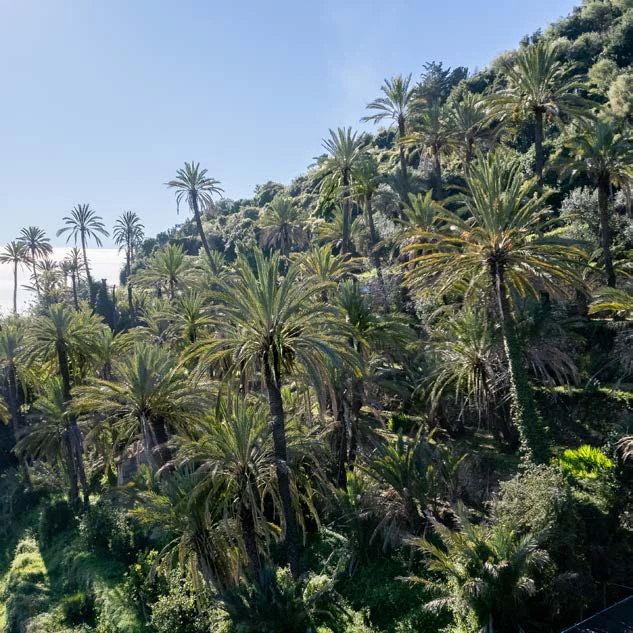
His relics have travelled more than he did: the Genoese took them to Sanremo in 1140 and then to Genoa in 1258, and they only returned to Bordighera on 16 August 1947, by sea. Today they are kept in the parish church of Bordighera Alta. And the palms? You can still find them in the Arziglia palm grove, considered the northernmost date palm grove in Europe.
Legends of the Ligurian Ponente
4. The witches of Triora
Triora, in the upper Valle Argentina, is known as the “village of witches”. Between 1587 and 1589, after a severe famine, a group of local women was accused of witchcraft and blamed for the hunger. The trial, one of the best known in Italy, led to arrests, interrogations and torture; some of the accused died in prison, until the government of Genoa stepped in to halt it. The records are kept in the State Archives of Genoa.
On the edge of the village stands the Cabotina, a small ruined building where, according to legend, the witches used to meet. The Museo Etnografico e della Stregoneria tells the story with documents and reconstructions: it is the right place to separate true history from folklore.
5. Dolceacqua, the michetta and the ius primae noctis
In Dolceacqua, beneath the castle of the Doria family, people eat a simple sweet with a dark story. It is said that a young bride, Lucrezia, refused to give herself to the lord of the castle, who claimed the ius primae noctis, and that she died a prisoner in the dungeons. The village, legend has it, invented the michetta to remember her and to celebrate the end of that supposed right. It is a legend, not historical fact, but every summer the village celebrates its sweet.
6. The Principality of Seborga
In the hills behind Bordighera there is a village that proclaims itself an independent state. For centuries Seborga was a fief of the Benedictine monks of the Abbey of Lérins, who minted coins here, until in 1729 the abbey sold it to Victor Amadeus II of Savoy. It was on that very sale that, in the 1960s, a flower grower, Giorgio Carbone, built his argument that Seborga had never legitimately become part of the Kingdom of Italy. In 1963 he was elected prince with the name Giorgio I.
The Principality has a white and blue flag, a motto and a currency, the luigino, but the Italian state does not recognise it: Seborga is a municipality in the province of Imperia. For visitors, though, it remains one of Liguria’s most charming curiosities.
7. The Balzi Rossi, home of prehistoric man
On the border with France, at Grimaldi di Ventimiglia, a cliff reddened by iron drops down to the sea. Tens of thousands of years ago, the caves of the Balzi Rossi were home to Neanderthals and later to the first Homo sapiens. Among the most famous finds is the Triple Burial, about 25,000 years old: an adult and two young people buried together with pierced shells, flints and red deer canines. A curiosity within a curiosity: the first museum was funded in 1898 by Thomas Hanbury, the Englishman who created the botanical gardens at La Mortola.
Historical curiosities: the English, painters and a first lady
8. A novel that brought the English to Bordighera
In 1855 the Ligurian writer Giovanni Ruffini published Doctor Antonio in English, in Edinburgh: the story of a young Englishwoman who, after a carriage accident right in Bordighera, is cared for by a patriot doctor. The novel was a success in the United Kingdom and helped British travellers discover the Riviera, and they began spending the winter here. So the English colony was born, with villas, gardens, an Anglican church, a library and even the first tennis courts.
9. Clarence Bicknell, the clergyman who spoke Esperanto
The most remarkable of Bordighera’s English residents was Clarence Bicknell (1842–1918), who arrived as an Anglican clergyman in the late 1870s and became a botanist, archaeologist and flower painter. He was among the first to study systematically the prehistoric rock engravings of the Vallée des Merveilles, on Mont Bégo, and was a committed supporter of Esperanto, the international language in which he wrote poems and hymns. In 1888 he founded the Museo Bicknell, which holds casts of the engravings, his butterflies and a large library.
10. Monet and the “fairy-tale garden”
Claude Monet arrived in Bordighera in January 1884 for a short working trip and ended up staying until early April. In those months he painted a number of canvases that sources put at between thirty-eight and fifty: palms, olive trees, the old village, the sea. He worked for a long time in Francesco Moreno’s park, which he described as a fairy-tale garden, and went up to Dolceacqua, where he called the old bridge “a jewel of lightness”. If you would like to find his viewpoints, read Monet in Bordighera.
11. Why it is called Lungomare Argentina
Bordighera’s seafront promenade bears the name of a faraway country for a precise reason: in July 1947 Eva Perón, wife of the Argentine president, spent a day in town during her European tour and inaugurated the Lungomare Argentina. Two years after the end of the war, that visit was seen as a sign of a fresh start for tourism. And the link between Liguria and Argentina, as you will shortly see, is far older.
Ligurian traditions that live on
12. The right to grumble
If you have heard that Ligurians are fond of complaining, there is a story for that too. It is said that in the days of the Republic of Genoa sailors could be hired on two kinds of contract, with or without the right to mugugno, that is, to grumble freely on board. The first paid a little less, and most sailors, tradition has it, preferred it. The word passed from Genoese into Italian, and the mugugno has become a trait of character that Ligurians claim with a wink.
13. Fasce and dry-stone walls
Look at a Ligurian hillside and you will see a staircase of terraces held up by stone walls without mortar: these are the fasce, built by hand over centuries of work to wrest farmland from the slopes for olives, vines and flowers. In 2018 the art of dry-stone walling was added to UNESCO’s Intangible Cultural Heritage list, through a joint nomination by Italy and other European countries. Around Bordighera, between Seborga, Vallebona and the Val Nervia, terraces of olive trees still shape the landscape.
14. The Christ of the Abyss at San Fruttuoso
In the bay of San Fruttuoso, between Camogli and Portofino, a bronze statue of Christ with raised arms stands on the seabed, some fifteen metres down. It was placed there in 1954, on the idea of the diver Duilio Marcante, who wanted to remember his friend Dario Gonzatti, who had died in those waters; it was sculpted by Guido Galletti. It has become the symbol of those who have devoted their lives to the sea and a memorial to those who died there, and today it lies within the Portofino Marine Protected Area.
15. Liguria, land of emigrants: the “xeneizes” of Buenos Aires
Between the 19th and 20th centuries a great many Ligurians left for the Americas, and a large community settled in Buenos Aires, in the port district of La Boca. In 1905 a group of emigrants, mostly of Genoese origin, founded Club Atlético Boca Juniors there, whose fans are still called xeneizes: a corruption of zeneizi, “Genoese” in dialect. The story of Italian emigration is told in Genoa at the Museo Nazionale dell’Emigrazione Italiana.
Liguria’s curiosities at the table
16. Pesto and the basil with a PDO
Pesto alla genovese is traditionally made in a marble mortar with a wooden pestle, and that is where it gets its name. The curious thing is that its main ingredient is protected: since 2005 Basilico Genovese has been a PDO, and only basil grown in Liguria according to the official specification can bear the name. Its small, tender leaves are the secret of a sweet, fragrant pesto.
17. Focaccia, or rather focacce
In Liguria “focaccia” does not mean just one thing. There is focaccia genovese, low and glistening with oil, which the Genoese even eat for breakfast dunked in their cappuccino; and there is Focaccia di Recco col formaggio, wafer-thin and filled with fresh cheese, which gained PGI status in 2015. In the Ponente the tradition changes again: here you will find sardenaira, with tomato, anchovies and olives, and many recipes you can discover in flavours of Bordighera.
Frequently asked questions
What are the most famous curiosities about Liguria?
Among the best known are the Bordighera palms that reach the Vatican for Palm Sunday, the witch trials of Triora, the Principality of Seborga, the Christ of the Abyss at San Fruttuoso, the Genoese sailors’ right to grumble and the dry-stone walls of the fasce, a UNESCO heritage.
What are the best-known Ligurian legends?
In the Ponente the famous ones are the legend of the witches of Triora, that of Lucrezia and the michetta in Dolceacqua, and that of Sant’Ampelio, the hermit who, according to tradition, brought date seeds to Bordighera. The episode of the cry “water on the ropes” in St Peter’s Square is also handed down as tradition.
What are Liguria’s traditions?
Ligurian traditions still alive today include weaving parmureli for Palm Sunday, building the fasce with dry-stone walls, pesto made in the mortar, focaccia and the patron saint festivals of the villages, such as that of Sant’Ampelio in Bordighera.
Why is Triora called the village of witches?
Because of the witchcraft trial held there between 1587 and 1589, when some women of the village were accused of causing a famine.
Why do the Vatican’s palms come from Liguria?
According to tradition, Pope Sixtus V granted the privilege to the Ligurian sailor Benedetto Bresca, who in 1586 is said to have saved the lifting of the obelisk in St Peter’s Square by shouting to wet the ropes. Since then the Riviera’s palms, particularly those of Bordighera and Sanremo, have been linked to Palm Sunday in Rome.