

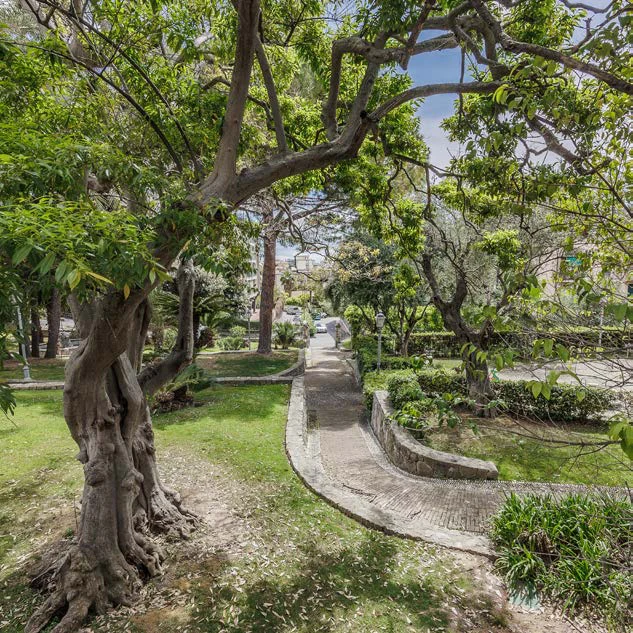
Along the Via Romana, a stone’s throw from the Canary Island pine, a small public garden bears the name of Claude Monet. It is one of the last fragments of the Moreno Garden, the park that at the end of the 19th century was famous throughout Europe and that in 1884 enchanted the Impressionist painter: here, among palms and plants from every corner of the world, Monet found some of the most luminous subjects of his stay in Bordighera.
“A garden like that is indescribable, it is pure magic, all the plants in the world grow there in the open ground” — Claude Monet, letter to Alice Hoschedé, 5 February 1884.
The Moreno Garden, one of the most famous in Europe
The story begins around 1830, when Vincenzo Moreno, a wealthy olive oil merchant from Bordighera, began collecting seeds and exotic plants on his travels and planting them on his estate. His son Francesco, also an olive oil merchant and French consul, continued the work: the property grew to about eighty hectares, from the sea up to the hill, with olives, oranges, lemons, mandarins and palms alongside rare species from far away.

By the end of the 19th century the Moreno Garden was one of the wonders of the Riviera and its fame reached well beyond Italy: writers, artists and travellers asked to visit it. But it was not open to everyone. You needed a letter of introduction.
Monet in the Moreno Garden
Claude Monet arrived in Bordighera in January 1884 for a three-week stay that turned into almost three months, lodging at the Pension Anglaise. When he heard about the garden of “a certain Monsieur Moreno”, which could not be visited without an introduction, he managed to get himself introduced.

He was won over: on 5 February he was already writing enthusiastically to Alice Hoschedé, describing it as an earthly paradise, a tangle of palms of every variety where the plants seemed to grow of their own accord. In the garden he painted some of his most famous canvases of the period:
- Garden in Bordighera, Impression of Morning, now at the Hermitage in St Petersburg;
- Olive Tree Wood in the Moreno Garden and Study of Olive Trees, in private collections;
- View of Ventimiglia, with the eye running from the garden along the coast, held at the Kelvingrove Art Gallery in Glasgow.
What remains today
After Francesco Moreno’s death in 1885, the estate was divided and sold in lots, and the great park disappeared. A few fragments survive: the public garden dedicated to Monet, between the Via Romana and Via Domenico Tumiati, and the parks of some private villas, such as Villa Schiva, where the Canary Island pine planted in the Morenos’ time towers above everything, and Villa Mariani, where the olive trees painted by Monet grow.

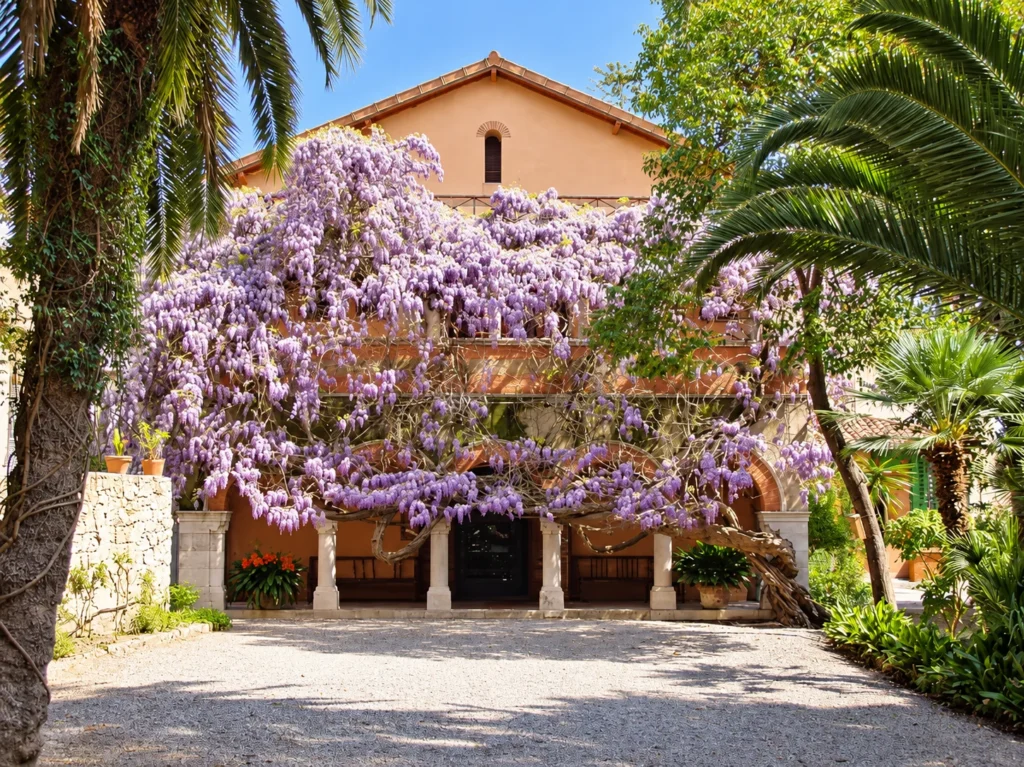
The Giardini Monet are a peaceful spot to pause along a walk on the Via Romana. Among palms, citrus and olive trees, the fountains and shady benches invite you to stop, while panels dedicated to Monet tell the story of his stay and help you imagine what this corner of Bordighera looked like when the painter set up his easel here. There is also a playground, which makes it a handy stop if you are travelling with children.
Getting there and opening times
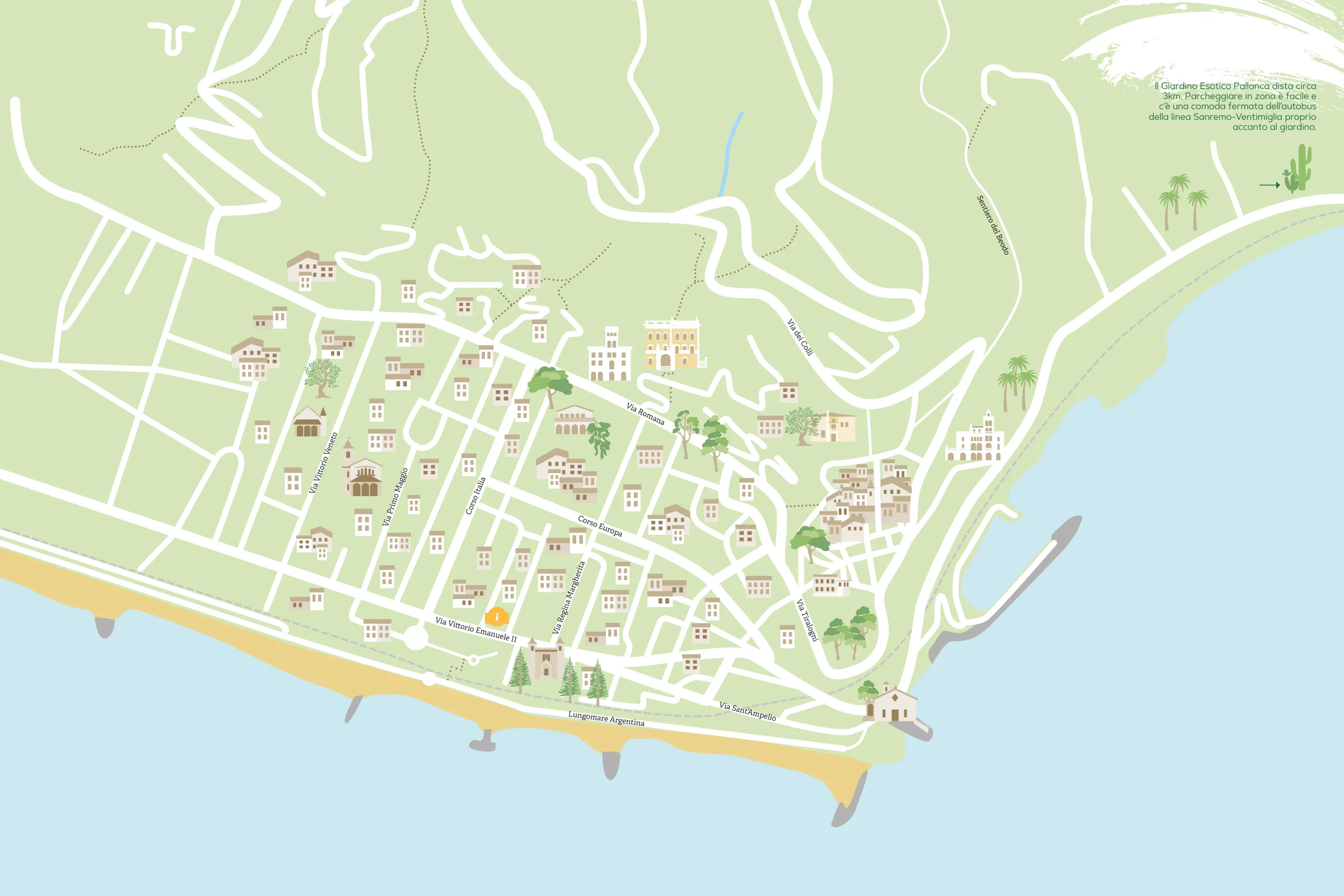
The gardens are on the Via Romana, in the eastern part towards Bordighera Alta, a few minutes’ walk from the centre. The “Giardini Monet” bus stop is right in front. They are a stop on the itinerary In Monet’s footsteps, marked on the ground by the “M” signs showing where the painter worked, and on the itinerary Gardens and monumental trees.

The gardens are open every day, with opening times that change according to the season.
Nearby
A few steps away, on the Via Romana through Monet’s eyes, you can stand on the “M” signs and compare the landscape with the paintings. Continuing along the Via Romana you will find Villa Etelinda, Villa Regina Margherita and the Museo Bicknell with its monumental fig trees. For the painter’s other places, walk up towards Bordighera Alta to the Pension Anglaise and the Fondazione Pompeo Mariani.

Frequently asked questions
Where are the Giardini Monet?
On the Via Romana, between the Via Romana and Via Domenico Tumiati, next to Villa Schiva and the Canary Island pine. The nearest bus stop is called “Giardini Monet”.
Why are they called the Giardini Monet?
Because they are a fragment of the Moreno Garden, where in 1884 Claude Monet painted some of his Bordighera canvases, including Garden in Bordighera, Impression of Morning.
What was the Moreno Garden?
An estate of about eighty hectares created by the Moreno family from 1830, famous throughout Europe for the variety of its plants. After 1885 it was divided and sold in lots.
When are the Giardini Monet open?
Every day, with opening times that vary according to the season.
Are they suitable for children?
Yes: besides the benches and fountains there is a playground, handy for a break during a walk along the Via Romana.
Can you see other Monet sites in Bordighera?
Yes: the “M” signs on the ground along the Via Romana, the Pension Anglaise where he stayed and the olive trees of the Moreno Garden in the park of Villa Mariani, which you can visit with the Fondazione Pompeo Mariani. You will find them all on the itinerary In Monet’s footsteps, and the full story of his stay in Monet in Bordighera.