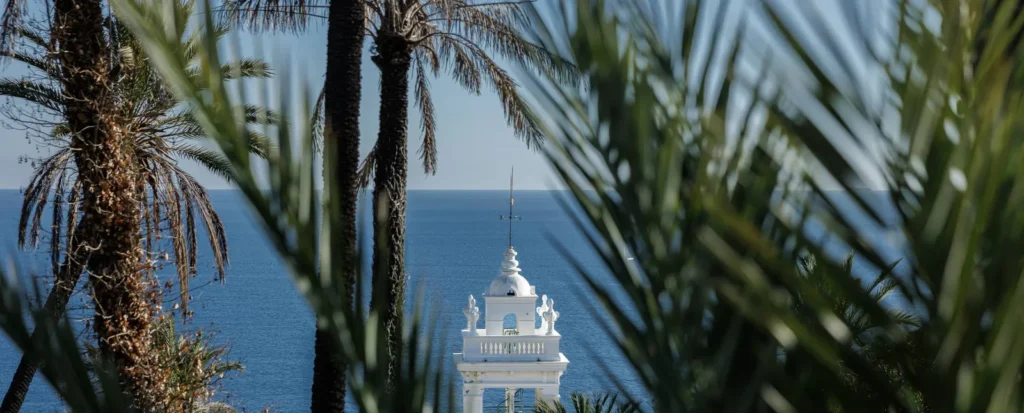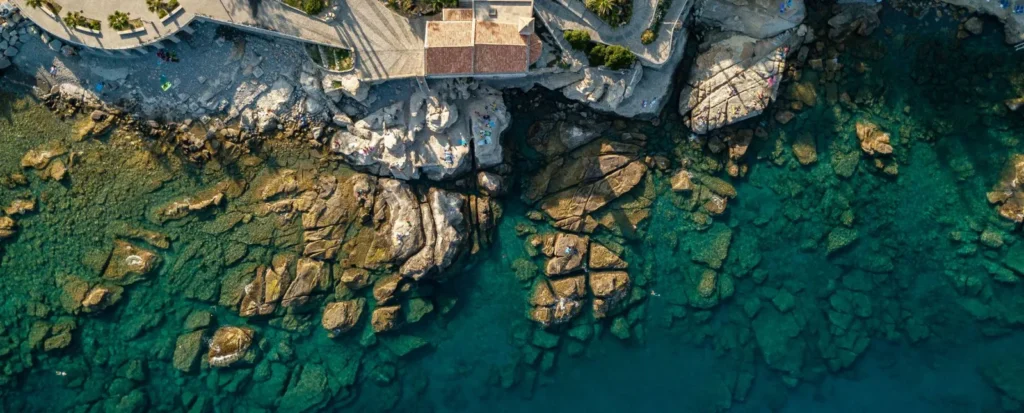


In 1884 Claude Monet stayed here, at the Pension Anglaise, the starting point of his explorations, his thoughts and his letters. Away from the fashionable crowd, he watched society life, the carnival and the spectacle of the sea. For almost three months, every morning, the painter left this guesthouse near the old town with his easel and canvases, to seek out the light of the Mediterranean among the palms, gardens and rocks.
“Everything is wonderful, and every day the countryside is more beautiful, and I am bewitched by the place” — Claude Monet, letter to the dealer Paul Durand-Ruel, 1884.
Three weeks that became three months
Monet had discovered the Riviera in December 1883, on a short one-week trip with his friend Pierre-Auguste Renoir. He came back so struck by it that he decided to leave again at once, this time alone: he arrived in Bordighera on 18 January 1884 and took lodgings at the Pension Anglaise, a few steps from the old town.
He intended to stay three weeks. Instead he stayed almost three months, until early April, working non-stop en plein air. Then he spent a few days in Menton and returned to France in mid-April, taking dozens of canvases with him.
Letters from the guesthouse
From the Pension Anglaise Monet wrote often to Alice Hoschedé, his partner waiting for him at Giverny, and to his dealer Paul Durand-Ruel. They are letters full of enthusiasm and torment. On one hand, wonder at the place, at the blue sea and at the Moreno Garden, which he called “pure magic”; on the other, the struggle with a landscape so different from his Normandy: the vegetation was dense and tangled, and the large isolated motifs he loved to paint were hard to find.
He wrote that he wanted to paint oranges and lemons against the blue sea but could not find them as he wished, and that the blue of the sea and sky was “impossible” to render. But little by little the light of the Riviera entered his palette, and never left it.
What he painted from here
From the guesthouse Monet walked to every corner of the town and its surroundings. His subjects included:
- The old town: three views of Bordighera Alta painted from Capo Sant’Ampelio, with the same framing from different heights, now divided between the Art Institute of Chicago, the Hammer Museum in Los Angeles and a private collection.
- The Moreno Garden: the palms, citrus and olive trees of the great park on the Via Romana, of which the Giardini Monet and the olive trees of Villa Mariani remain today.
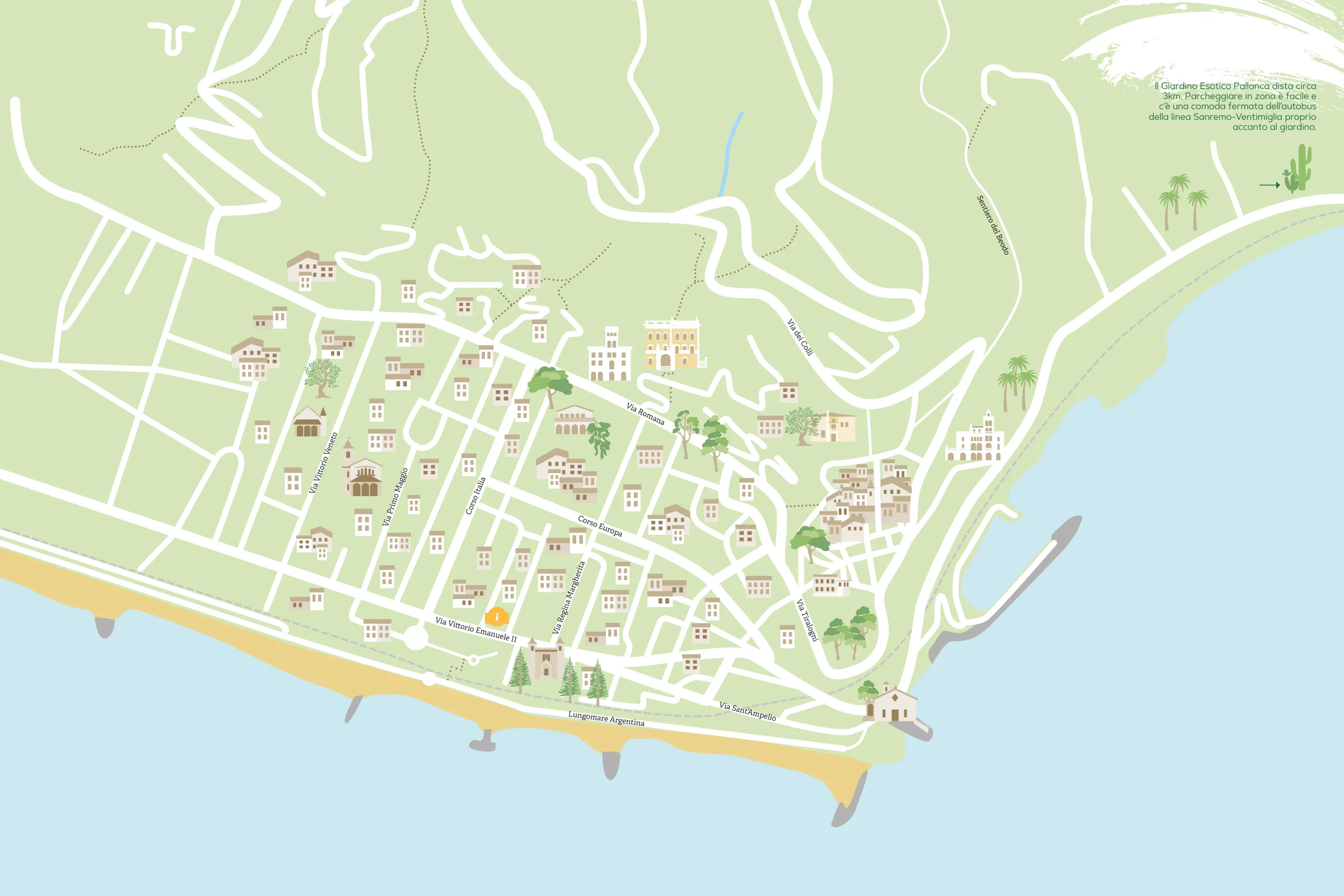
- The Via Romana and the villas: the spots where he set up his easel are marked on the ground by the “M” signs of the Via Romana through Monet’s eyes.
- The hinterland: the Vallone del Sasso and, further away, Dolceacqua, with its old bridge and the castle of the Doria family.
The Bordighera of the foreigners
When Monet stayed here, Bordighera was one of the most elegant winter destinations in Europe. The railway had arrived only a little over ten years earlier, and the town had filled with hotels, guesthouses and villas inhabited by the English, French and Germans. Among the best-known figures was the French architect Charles Garnier (1825–1898), designer of the Paris Opéra, who had built his own villa here and designed several buildings on the Riviera and in Bordighera.
Monet watched this society life from a distance: his interest was entirely in the landscape, and the guesthouse near the old village was the ideal starting point for reaching it.
The Pension Anglaise today
The building that housed the Pension Anglaise stands in Via XX Settembre, the street that climbs from the centre towards the old town, the same one as Palazzo Garnier. Today it is abandoned and cannot be visited: it can only be seen from outside, from the street. It is still worth a stop, to imagine the painter leaving it in the morning with his easel on his shoulders.
The Pension Anglaise is a stop on the itinerary In Monet’s footsteps, which follows the places the painter lived in and painted, with the illustrated map and the waymarker stones along the route.
Nearby
A few steps away is Bordighera Alta, the medieval village Monet painted from the Capo; a little higher up, the Fondazione Pompeo Mariani, with the olive trees of the Moreno Garden. Heading down to the west you reach the Via Romana and the Giardini Monet. For the full story of his stay, read Monet in Bordighera.
Frequently asked questions
Where did Monet stay in Bordighera?
At the Pension Anglaise, near the old town, where he arrived on 18 January 1884 and stayed until early April.
Where is the Pension Anglaise?
In Via XX Settembre, the street that climbs from the centre towards Bordighera Alta, the same one as Palazzo Garnier.
How long did Monet stay in Bordighera?
Almost three months, from 18 January to early April 1884, although at first he planned to stay only three weeks.
How many paintings did Monet paint in Bordighera?
Dozens of canvases: sources give a number between about forty and more than fifty, across Bordighera, the surrounding area and Dolceacqua.
Can you visit the Pension Anglaise?
No, the building is now abandoned and can only be seen from outside, from Via XX Settembre.