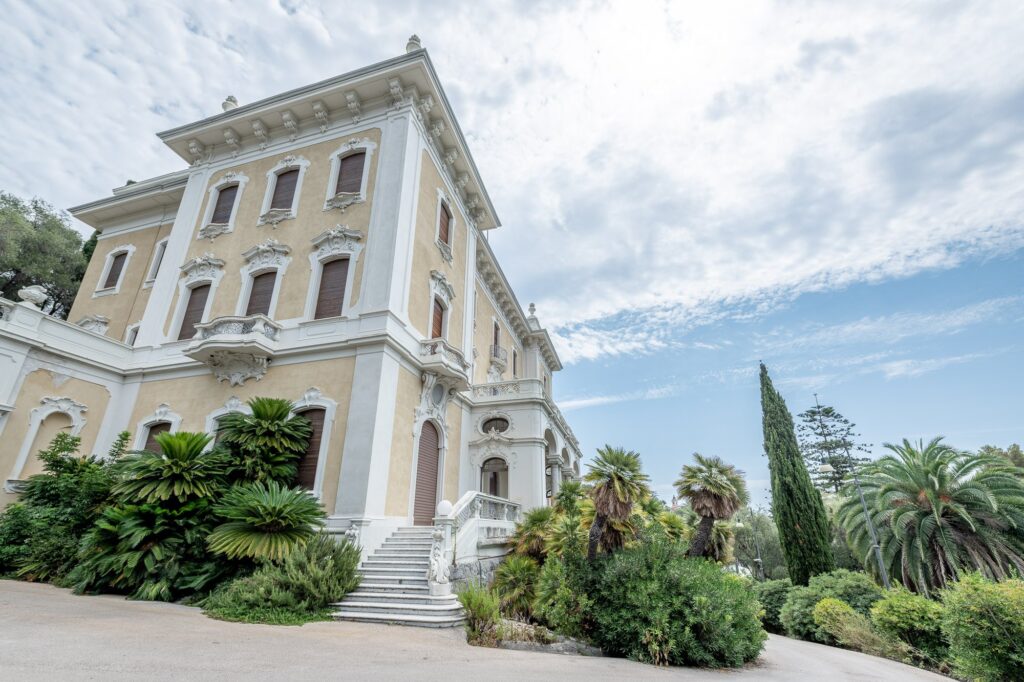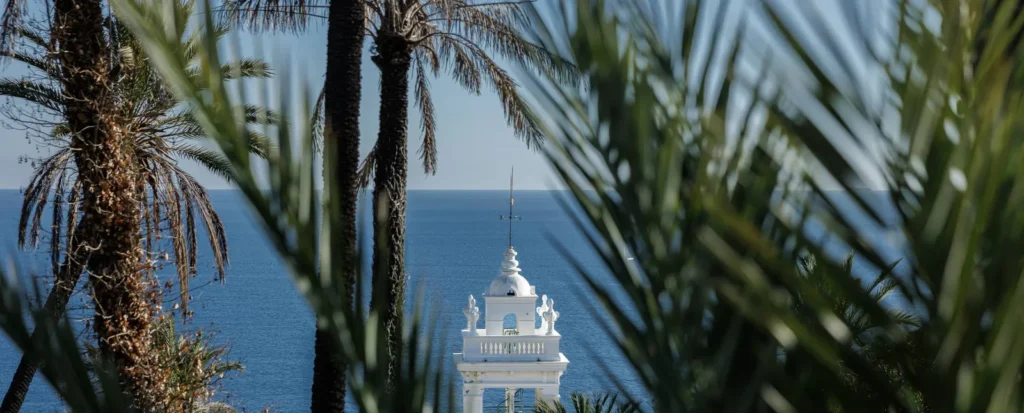


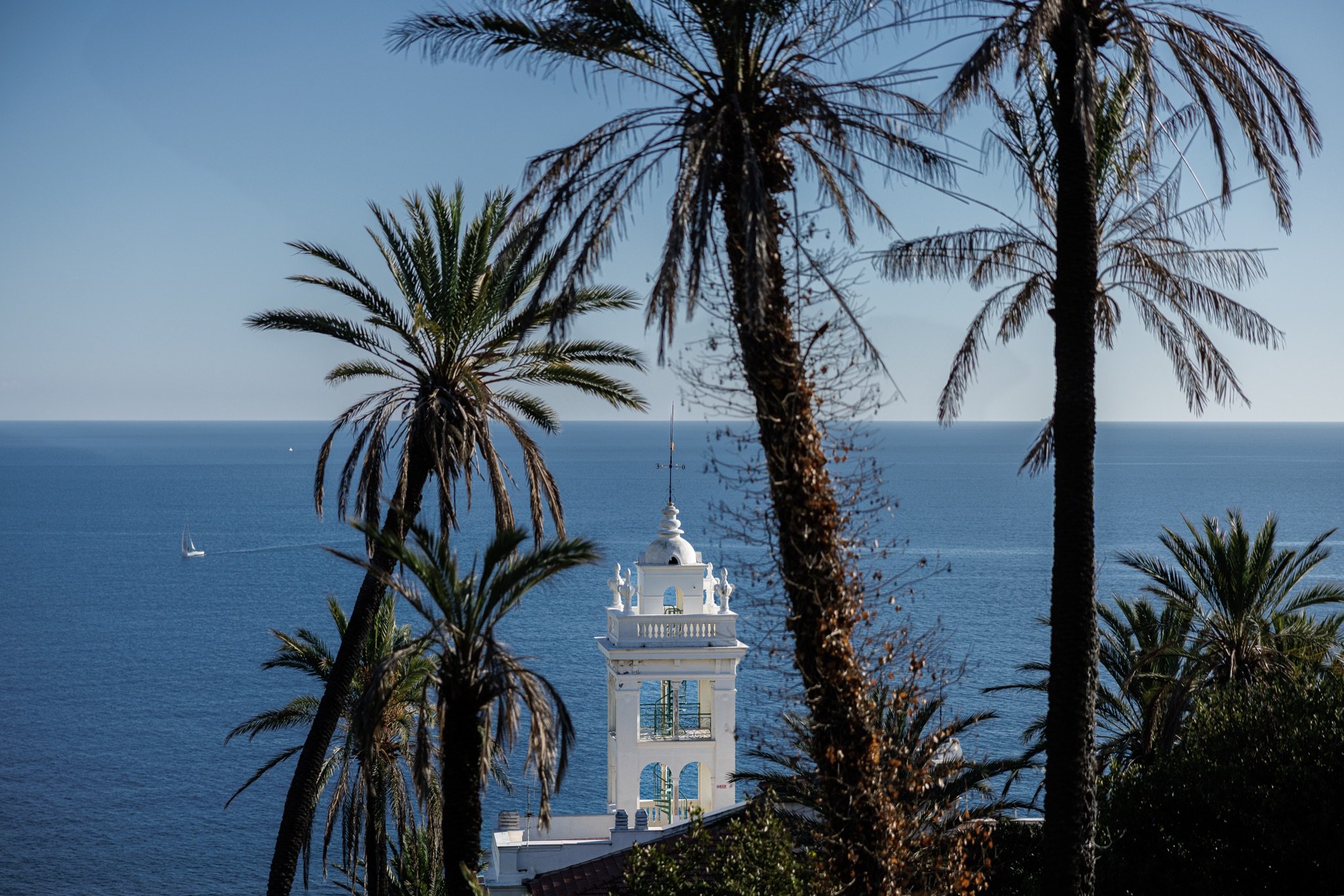
At Arziglia, on a terrace overlooking the sea, a white villa with a slender turret rises among the palms: this is Villa Garnier, the house that Charles Garnier, architect of the Paris Opéra and of the Monte-Carlo Casino, built for himself and his family from 1871. He spent his winters here for almost thirty years, and from here he changed the face of Bordighera.
Today the villa belongs to the Sisters of St Joseph of Aosta, who run it as a holiday house. On request you can visit the frescoed rooms on the ground floor, the chapel and the terraced garden with its palms.
Charles Garnier’s house
In 1871, as Paris emerged from the war with Prussia and the days of the Commune, Charles Garnier left the capital, where he was still building the Opéra, and came down to the Riviera. In May he chose an isolated plot near Arziglia in Bordighera, with an open view of the sea. To build the villa he also had to clear the site of the town school: in exchange he paid the town council for a new school building, which he designed himself and which is now Palazzo Garnier, the town hall.

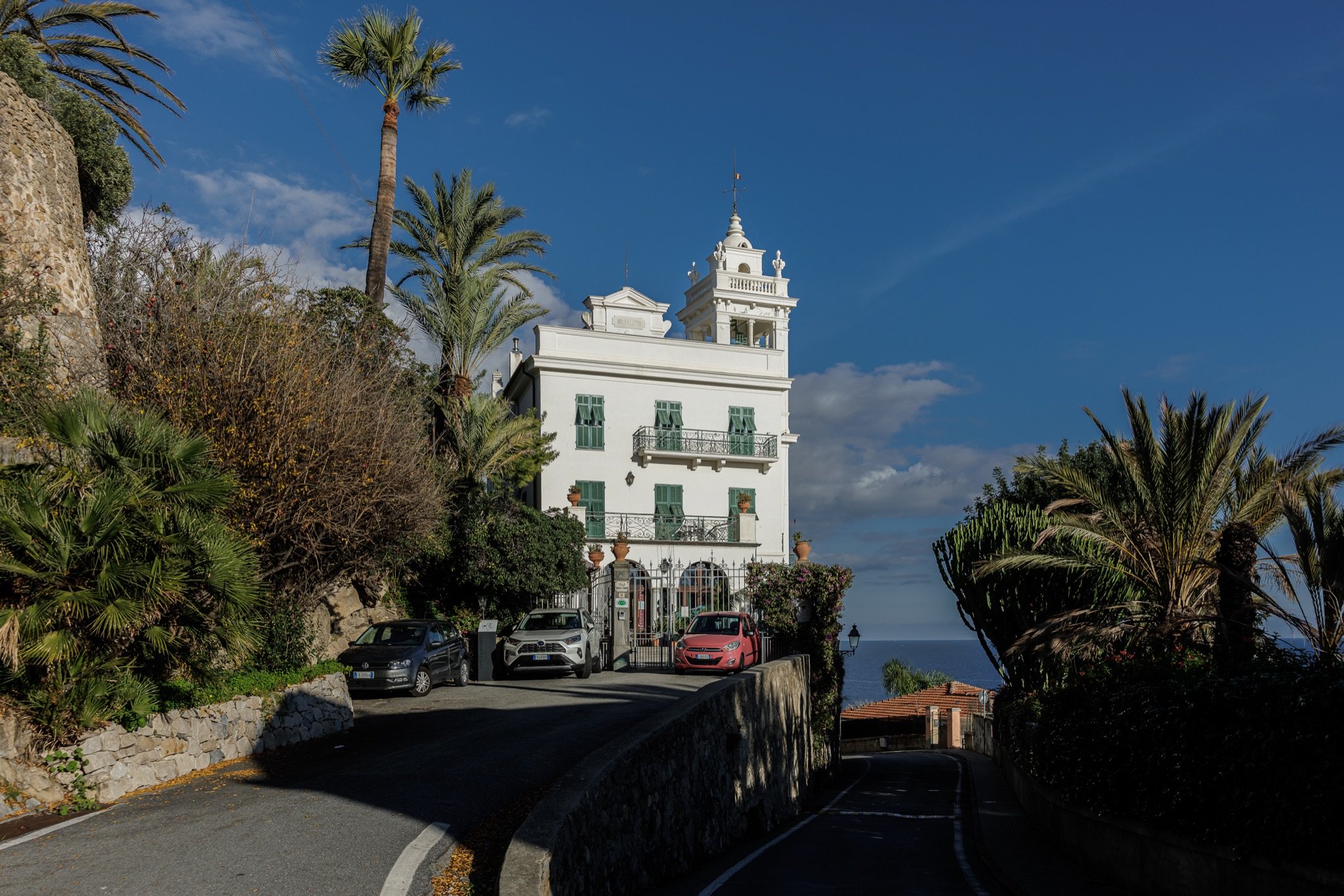
The villa was built between 1871 and 1873: three floors, an arched entrance portico and a slender turret, which Garnier fondly called “mon mirador”, his lookout over the sea. It became a model for many villas on the Riviera. In the following years the architect bought, in twenty-nine separate purchases, the neighbouring land and villas to protect his privacy and his view; in 1884 he built the Villa Studio next door, where he had his workshop.
In Bordighera Garnier was not just a distinguished guest. He designed Villa Etelinda, the church of Terrasanta and the new route of the Via Romana, and wrote a book, Les sujets artistiques de Bordighera, to invite artists to discover the town. He also asked the council to protect three landscapes he considered precious: the village of Bordighera Alta, the Sasso valley and the headland of Sant’Ampelio.
After Garnier
Charles Garnier died in 1898. His wife Louise left the villa to the Société de Géographie in Paris, but in 1929 the property was sold to the American art critic John Hemming Fry. It then passed to the Diocese of Ventimiglia and, since 1954, has belonged to the Congregation of the Sisters of St Joseph of Aosta. The villa is protected as an architectural heritage site by the Soprintendenza.

What to see
The rooms and the chapel
The visit includes the ground-floor rooms, decorated with wall paintings. Garnier gathered his artist friends here, and on the walls remain works and caricatures linked to painters such as Ernest Meissonier and Gustave Boulanger. The chapel has a large fresco by Garnier himself.
The terraced garden
The park originally covered about 6,000 square metres, on terraces planted with olives, figs, lemons, oranges and palms. It was looked after by Garnier’s son, Christian, with the landscape gardener Ludwig Winter. Today about 2,500 square metres can be visited, on two terraces, with around ten species of palm, succulents and Mediterranean trees. The writer Edmondo De Amicis called it “the royal palace of palms”.

Carpeaux’s bust and the Tuileries column
Among the plants you will come across two mementoes of Garnier’s Paris: a bust of the architect by the sculptor Jean-Baptiste Carpeaux and a column from the Tuileries Palace, the royal residence destroyed during the Commune.

Tips for your visit
- How to visit: the villa can be visited on request, for a free-will donation. Contact the sisters in advance (tel. +39 0184 261833, info@villagarnier.it) to arrange a day and time.
- Staying at the villa: Villa Garnier is also a holiday house, with rooms and apartments; opening periods and bookings on villagarnier.it.
- Respect the place: it is a lived-in religious house, so keep your voice down during the visit.
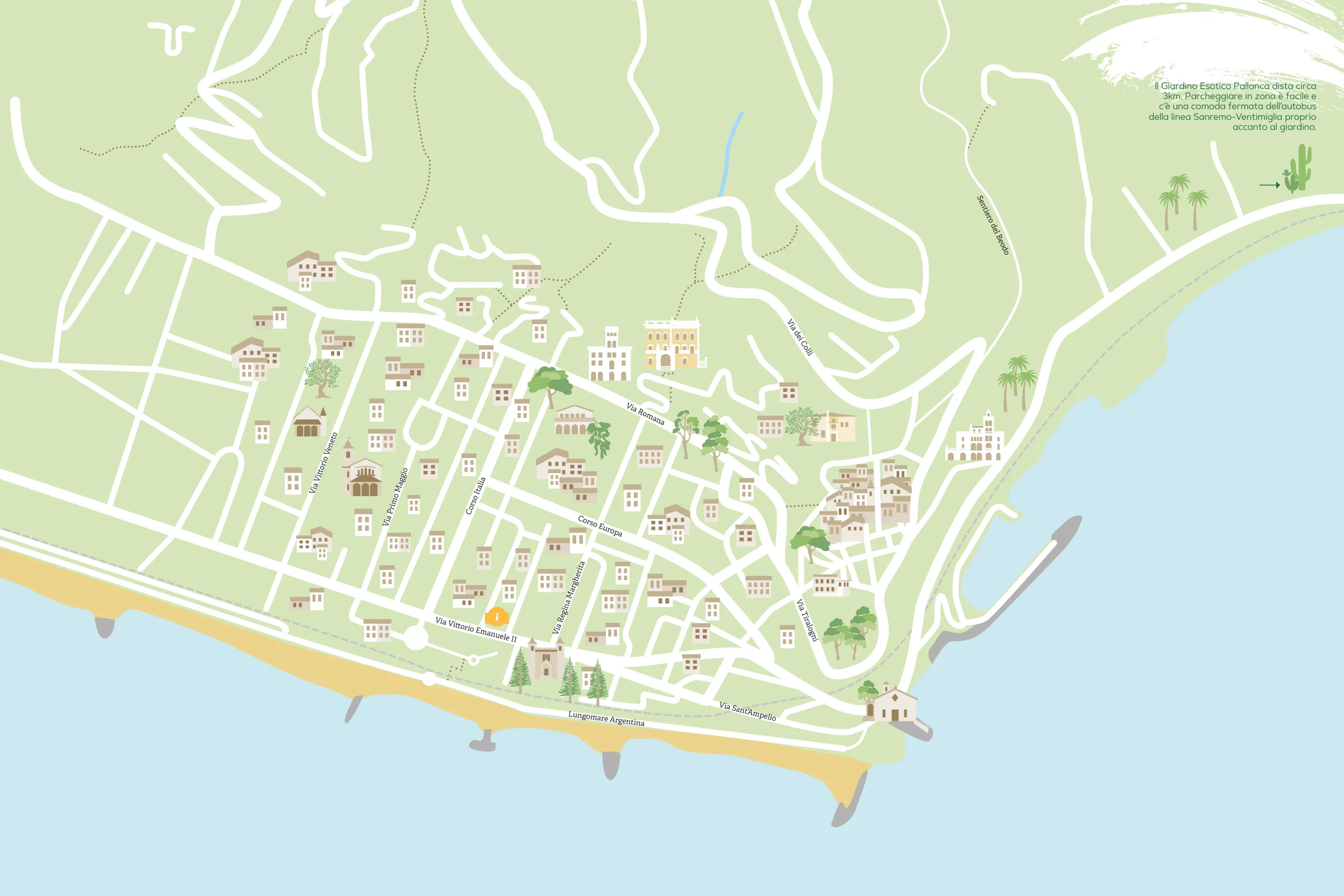
- Combine it with: the Giardini Winter and the Arziglia palm grove, a short walk away, and the Sentiero del Beodo, one of Garnier’s favourite walks.
Frequently asked questions
Can you visit Villa Garnier?
Yes, on request and for a free-will donation. The visit includes the frescoed ground-floor rooms, the chapel and the garden. It is best to contact the villa in advance.
Who was Charles Garnier?
A French architect (1825–1898), designer of the Paris Opéra and the Monte-Carlo Casino. From 1871 he spent his winters in Bordighera and designed several buildings there, including the town hall and the church of Terrasanta.
Who owns the villa today?
Since 1954 the Congregation of the Sisters of St Joseph of Aosta, who run it as a holiday house.
Can you stay at Villa Garnier?
Yes, the villa houses a holiday home with rooms and apartments. Check the official website for opening periods.
Where is it?
At Via Charles Garnier 11, in the Arziglia area at the eastern end of Bordighera, near the Giardini Winter.