

In brief
The plants of Liguria tell the story of a region squeezed between the mountains and the sea: within a few kilometres you pass from the Mediterranean scrub of the coast to the woods and flower meadows of the Ligurian Alps. On the Riviera di Ponente, sheltered by the mountains, this native flora was joined in the 19th century by palms, cacti and trees from every continent, which grow outdoors here all year round.
In this guide you will find the typical plants of Liguria, the story of the palms and exotic gardens of the Riviera dei Fiori, and the gardens to visit across the region, from Ventimiglia to La Spezia. With a special focus on Bordighera, the “city of palms”, where an ancient palm grove, the gardens of the 19th-century botanists and seven monumental trees can all be discovered on foot.
The typical flora of Liguria
Liguria is a region of steep slopes facing the sea. Along the coast the Mediterranean scrub dominates: evergreen shrubs with small, leathery leaves suited to dry summers, such as mastic, strawberry tree, myrtle, phillyrea, Mediterranean buckthorn, broom and aromatic plants like thyme, rosemary and bay. Where the woodland has had time to grow, the scrub gives way to holm oak forests, woods of holm oak, the evergreen oak of the Mediterranean, which in Liguria also climbs the slopes facing the sea.
Pines and the olive tree
Two native pines grow on the coastal hills. The maritime pine forms open woods, mainly on acid soils, among the holm oak and oak woods of the Ligurian Alps and the Apennines. The Aleppo pine is rarer, but Liguria is one of the Italian regions where it forms natural stands, usually on limestone soils near the sea.
The plant that shapes the landscape more than any other, however, was planted by people: the olive tree. For centuries the Ligurians built fasce, terraces held up by dry-stone walls, to grow olives, vines and citrus fruit on the steepest slopes. Around Bordighera the olive terraces reach right to the edge of town: the Giardini Lowe, in the very centre, are a small olive grove of more than sixty centuries-old trees that has become a public park.
Flowers that grow only here
The mountains of the Ponente are among the places in the Alps richest in endemic species, that is, plants that live only in a restricted area: during the ice ages some ice-free peaks acted as a refuge for the flora. Among the endemic plants of Liguria is the Savona bellflower (Campanula sabatia), which grows only in western Liguria and in a few nearby sites in Piedmont, and is protected by regional law. In the Parco delle Alpi Liguri, above the Val Nervia, you will also find Bicknell’s rhaponticum, named after the English botanist who studied the flora of the Riviera from Bordighera.
Why exotic plants grow in the Ponente
The secret is the climate. The Maritime and Ligurian Alps, a few kilometres from the coast, shield it from the cold northern winds, and the sea softens the winter: a mild climate that already in the 19th century drew travellers from northern Europe to spend the winter on the Riviera, and which allows palms, succulents and subtropical trees to live outdoors. Plants that in much of Europe survive only in a greenhouse become trees here.
The palms of Liguria: from Sant’Ampelio to the Riviera dei Fiori
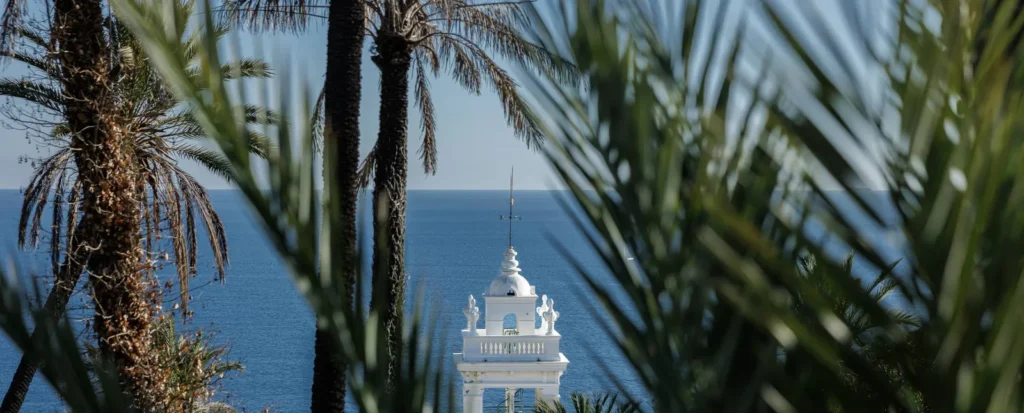
Palms are the symbol of the Riviera di Ponente, and their story begins in Bordighera. According to tradition it was Sant’Ampelio, the hermit from Egypt who lived on the Capo between the 4th and 5th centuries, who brought the date stones from which the first palms grew. More likely, the palm grove of the valle del Sasso dates back to the Middle Ages. At a latitude of 43° 47′ it is considered the northernmost date palm grove in Europe.
For centuries palms were not an ornament but a livelihood. In summer the parmurà, the growers of Bordighera and Sanremo, tied up the crowns of the palms so that the new leaves would grow in the dark and turn pale, the colour of ivory; in spring they cut them and wove them for Palm Sunday. It is said that in 1586 the Ligurian captain Benedetto Bresca saved the raising of the obelisk in St Peter’s Square by shouting to wet the ropes, and that to thank him the pope granted his homeland the privilege of supplying palms to the Vatican.
The English colony and the 19th-century gardens
In the 19th century the palm landscape won over foreign travellers. Bordighera became one of the favourite winter destinations of the British, who built villas, churches and gardens. In 1867 Thomas Hanbury, who had made his fortune in China in the tea trade, bought the promontory of La Mortola and began creating the Giardini Botanici Hanbury. For some years the German gardener Ludwig Winter worked alongside him; in 1875 Winter settled in Bordighera and created at the Arziglia a garden nursery where he acclimatised palms and exotic plants to be shipped all over Europe. What remains of it are the Giardini Winter, a public garden reopened in 2015.
In the same years the architect Charles Garnier built himself Villa Garnier in Bordighera, with a terraced palm garden tended by his son and by Winter, and the naturalist Clarence Bicknell studied and painted the flora of the Riviera. Sanremo also has its historic gardens, starting with the palms of Corso Imperatrice, which according to tradition were donated by the Empress of Russia, Maria Alexandrovna.
How the “Riviera dei Fiori” was born
Between the late 19th and early 20th centuries the coast around Imperia changed its face once again: on the terraces, alongside and in place of citrus and palms, came cut flowers, grown for the markets of northern Europe. Sanremo’s first flower market was organised in 1914, and in 1925 the Experimental Floriculture Station was founded at the instigation of Mario Calvino and Eva Mameli, the parents of Italo Calvino, to support with research a floriculture that was becoming an industry. Today the province of Imperia specialises above all in cut flowers and ornamental foliage, and this is where the name “Riviera dei Fiori”, used for the coast of the Ponente, comes from. To get to know this stretch of coast, start from the page on the Riviera dei Fiori.
Gardens to visit in Liguria, area by area
From botanical gardens to the parks of historic villas, here are the gardens of Liguria worth putting on your list, from west to east. Opening hours and tickets change with the seasons: check them on the official websites.
Riviera di Ponente: Hanbury, Bordighera and Sanremo
- Giardini Botanici Hanbury, at La Mortola (Ventimiglia). Eighteen hectares of terraces descending from the palazzo to the sea, with plants from every continent, especially tropical and subtropical ones. Today it belongs to the State and since 1987 has been managed by the University of Genoa. Allow at least two hours.
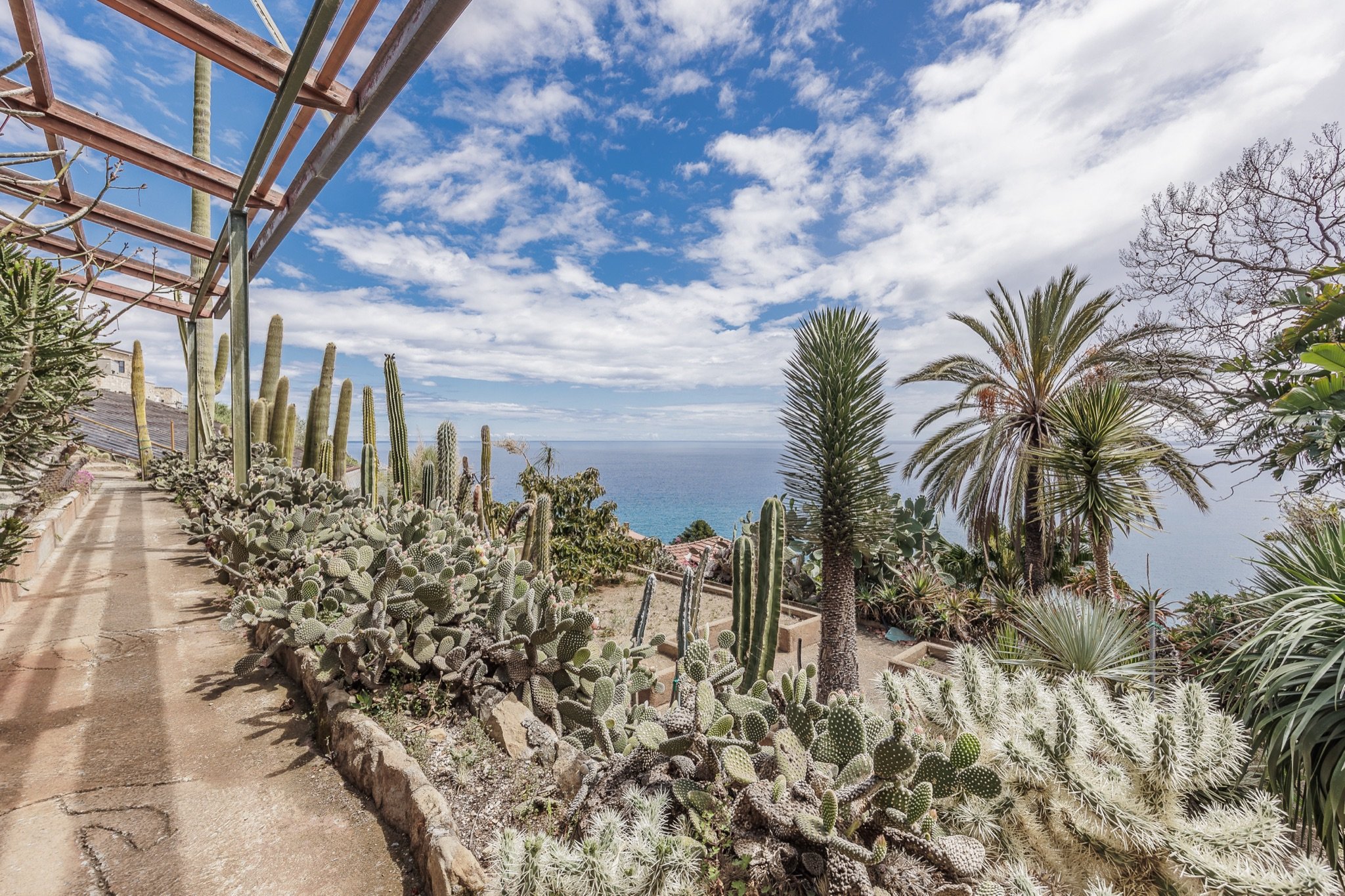
- Giardino Esotico Pallanca, in Bordighera. One of the richest collections of cacti and succulents in Europe: more than 3,000 varieties on 10,000 square metres of terraces among the rocks of the Arziglia, the work of four generations of a family of nurserymen who were pupils of Winter. The “patriarch” is a Chilean Copiapoa more than 300 years old.
- The gardens of Bordighera. As well as the Giardini Winter and the Giardini Lowe, in town you will find the Giardini Monet, the last fragment of the Giardino Moreno that enchanted the painter in 1884, and the pine wood of the Capo running down from Bordighera Alta to the sea. You will find them all on the page Gardens and trees of Bordighera.
- Villa Ormond, in Sanremo. The public park of the villa built for the Swiss Ormond family and bought by the Comune in 1930: an Italian garden at its centre, areas devoted to palms, ficus and cedars, and a Japanese garden created through the twinning with the city of Atami.
- Villa Nobel, in Sanremo. The villa where Alfred Nobel spent his last years and where he died in 1896, now a museum, with a garden of about 6,000 square metres of exotic and local plants.
Savona area: the Giardini di Villa della Pergola in Alassio
On the hillside of Alassio, the Giardini di Villa della Pergola are a late 19th-century park of about 22,000 square metres, saved in 2006 and restored by the landscape architect Paolo Pejrone. It is known for two collections: wisteria, with more than thirty varieties, and agapanthus, almost 500 species and varieties, which according to the curators form the most important collection in Europe. Visits are by guided tour, booking required.
Genoa and around
- Villa Durazzo Pallavicini, in Pegli. A romantic park created between 1840 and 1846 by the set designer Michele Canzio for Marquis Ignazio Pallavicini: a theatrical route among grottoes, a pond with a Chinese pagoda, small temples and bridges, with old camellias, a monumental camphor tree and a cedar of Lebanon. Next to it is the Clelia Durazzo Grimaldi botanical garden, created in the late 18th century from the Marchioness’s passion for botany.
- Parchi di Nervi, east of Genoa. The gardens of four historic villas (Gropallo, Saluzzo Serra, Grimaldi Fassio and Luxoro) joined into one large park by the sea, with English-style lawns, palms, rare trees and a rose garden of more than 200 varieties.
Riviera di Levante
- Villa Durazzo, in Santa Margherita Ligure. A historic park of about three hectares on the hill above the harbour: a citrus grove, an Italian garden with box and myrtle hedges, 19th-century cycads and camellias, and a romantic English-style wood with exotic plants.
- Orto botanico di Montemarcello, in the Parco di Montemarcello-Magra-Vara. At the top of the Caprione promontory, between the Gulf of La Spezia and the mouth of the Magra, it is the right place to get a close look at Liguria’s native flora: holm oak, strawberry tree, mastic, phillyrea, Aleppo pine and several wild orchids.
The monumental trees of Bordighera
If you love trees, Bordighera holds a record: with seven trees listed in the national register of monumental trees of Italy, it is the municipality in the province of Imperia with the most monumental trees. They are just a few steps from one another:
- the wisteria that every spring cloaks the façade of the Museo Bicknell in purple;
- the two Moreton Bay figs in front of the same museum, planted by Clarence Bicknell, whose roots have swallowed up the wall and the gate;
- the Moreton Bay fig of Palazzo Garnier, the town hall designed by Charles Garnier at the entrance to Bordighera Alta;
- the row of more than fifty araucarias, Norfolk Island pines, lining the Lungomare Argentina;
- the Canary Island pine on Via Romana, 40 metres tall and planted around 1830 in the Giardino Moreno;
- the olive trees of Monet, the centuries-old olives painted by the artist in 1884, now in the park of Villa Mariani.
The itinerary Gardens and monumental trees links them all in a single walk. Some grow on private property and can be admired from the street or on guided tours.
When to go: blooming seasons in Liguria
- Winter: palms, agaves and succulents are always green. In February the mimosa blooms, colouring the hills: in Pieve Ligure, on the Golfo Paradiso, it has its own festival.
- Late winter and early spring: this is camellia season, the stars of the historic parks of Pegli and Santa Margherita. In March Sanremo celebrates its flowers with the flower parade.
- Spring: between April and May the wisteria blooms, from the monumental one at the Museo Bicknell to the collection at Villa della Pergola, and the great gardens are at their most colourful. It is the best time for Hanbury.
- Summer: between June and July the agapanthus of Alassio come into flower. In the hottest hours seek the shade of the olives in the Giardini Lowe or the pine wood of the Capo, and visit the gardens early in the morning.
- Autumn: clear light and mild temperatures, ideal for the larger gardens and for the valle del Sasso.
Frequently asked questions
What are the typical plants of Liguria?
On the coast, Mediterranean scrub (mastic, strawberry tree, myrtle, broom, thyme and rosemary), holm oak, maritime pine and Aleppo pine. The plant that symbolises the landscape is the olive, grown on the fasce terraces; in the Ponente palms and exotic plants also grow outdoors.
What are the most beautiful gardens to visit in Liguria?
In the Ponente, the Giardini Botanici Hanbury at La Mortola, the Giardino Esotico Pallanca in Bordighera and the park of Villa Ormond in Sanremo; in Alassio, the Giardini di Villa della Pergola; in Genoa, the park of Villa Durazzo Pallavicini in Pegli and the Parchi di Nervi; in the Levante, the park of Villa Durazzo in Santa Margherita Ligure and the Orto botanico di Montemarcello.
Why are there palm trees in Liguria?
Because the Ligurian Ponente, sheltered by the mountains and tempered by the sea, has mild winters. In Bordighera date palms have been grown for centuries for the woven palms of Palm Sunday; in the 19th century botanists and gardeners such as Ludwig Winter introduced many other species.
Where is the northernmost palm grove in Europe?
In Bordighera, in the valle del Sasso: it is considered the northernmost date palm grove in Europe. The loveliest way to see it is the Sentiero del Beodo, which starts from Bordighera Alta.
Why is it called the Riviera dei Fiori?
Because of floriculture: between the late 19th and early 20th centuries the coast of the province of Imperia filled up with fields of cut flowers, exported all over Europe. Sanremo had its first flower market in 1914.
How much time do you need to visit the Giardini Hanbury?
At least two hours, or half a day if you want to wander down to the sea at a leisurely pace. From Bordighera it takes about 25 minutes by car.
Updated 3 October 2026