

In brief
The history of Bordighera is that of a small village of farmers and fishermen that became, within a few decades of the 19th century, one of the most elegant holiday resorts in Europe. Along the way there is a hermit from Egypt, thirty-two families who decide to rebuild an abandoned village, a “republic” of eight villages, an English novel and a queen.
In this article we retrace the main moments, from the fortified villages of prehistory to the 20th century. For each period we also point out the places where you can still find it today, walking around the town.
Before Bordighera: castellari and Roman roads
The oldest traces are found on the hills. On Monte Nero and at Sapergo, opposite Sasso, stood two castellari, fortified villages of the pre-Roman Ligurians; the one at Sapergo, discovered in 1970, has revealed dry-stone walls later overlaid by Roman and medieval masonry.
In Roman times the area belonged to Albintimilium, present-day Ventimiglia. In 13 BC the via Julia Augusta was opened, linking Italy with Gaul and running along the foot of the hill, on the route of today’s via Romana. On the plain, in 1955, a tomb from the imperial age was found, now reassembled at the Museo Bicknell: evidence of a Roman farming settlement.
Sant’Ampelio and the Middle Ages
According to tradition, between the 4th and 5th centuries a hermit from the Thebaid, in Egypt, landed on the Capo: Ampelio. He lived in a cave among the rocks, worked as a blacksmith and, so it is said, brought with him the date stones from which the first palms grew. Over his cave rose the church of Sant’Ampelio, an 11th-century Romanesque building that the archaeologist Nino Lamboglia called a “palimpsest of ten centuries of history”. In the Middle Ages the Capo had a Benedictine priory and a castle, destroyed by the Genoese in the 13th century.
The saint’s relics had an eventful history: in 1140 Genoa had them taken to Sanremo, and in 1258 to Genoa, where they remained for almost seven centuries. They returned to Bordighera by sea only on 16 August 1947. The town still celebrates its patron saint on 14 May, as described in our article on the feast of Sant’Ampelio.
The name appears in a document of 1296, a bull of Pope Boniface VIII that mentions the monastery of Sant’Ampelio “subtus Burdigheta”. According to the most widely accepted theory, Burdigheta comes from bordigue, a fish trap, that is, a basin for fish closed off by reed screens. In 1340 the village numbered just fifteen families and was subject to Ventimiglia; later it was abandoned.
1470: the birth of Bordighera Alta
The birth date of today’s Bordighera is 2 September 1470. That day thirty-two families from the Castrum Sancti Nicolai, present-day Borghetto San Nicolò, met in their parish church and decided to rebuild the abandoned village “in capo a Burdigheta”. A deed of 18 June 1471 confirmed the decision. The new inhabitants were farmers and fishermen.
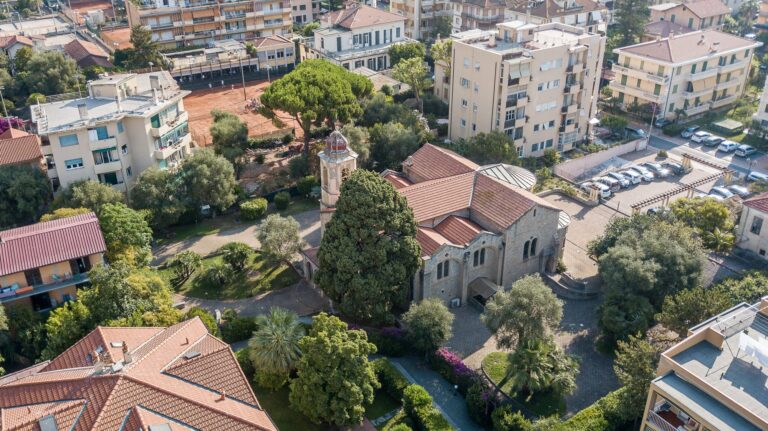
This is how Bordighera Alta came into being, a village laid out as an irregular pentagon, enclosed by walls strengthened in the mid-16th century against pirate raids. In 1543, while the Turkish fleet was besieging Nice, pirates landed at Arziglia and captured men, women and children from the nearby villages. The bell tower of the church of Santa Maria Maddalena was originally a watchtower. Of the fortified village, the gates remain: the Porta Sottana, with the Genoese coat of arms of St George, the 17th-century Porta del Capo, and the Porta Soprana, or Porta della Maddalena, from 1780.
The Magnifica Comunità degli Otto Luoghi
For two centuries Bordighera remained under Ventimiglia, within the Republic of Genoa. Then, in 1673, eight villages decided to break away: Bordighera, Borghetto, Camporosso, San Biagio, Soldano, Sasso, Vallebona and Vallecrosia. On 21 April 1686 the Magnifica Comunità degli Otto Luoghi (the Magnificent Community of the Eight Places) was born, a peaceful secession that gave the villages their own administration, still under the sovereignty of Genoa. Both dates are recorded on a plaque on the Oratorio di San Bartolomeo in Bordighera Alta. The Community lasted until the Napoleonic era, and the town’s municipal Statute still mentions it today among the origins of the town.
From Napoleon to the Unification of Italy
Under the Ligurian Republic, in 1797, Bordighera became part of the “Giurisdizione delle Palme” (Jurisdiction of the Palms), with Sanremo as its capital. In 1812 the three cannons of the Marabutto battery, on the beach, failed to prevent a landing by English ships. After the Congress of Vienna, in 1815, the village passed to the Kingdom of Sardinia, and in 1818 the new coast road commissioned by Napoleon, the “Grande Cornice”, arrived. When the Kingdom of Italy was born, in 1861, Bordighera had about 1,600 inhabitants.
The 19th century: the English arrive
Everything changed with a novel. In 1855 the Ligurian writer Giovanni Ruffini published Doctor Antonio in Edinburgh, in English: the love story between a young Englishwoman and an Italian doctor, set among the palms of Bordighera. The book was a great success and prompted the first British travellers to seek out the landscape of the novel. In 1860 the first hotel opened, the Hotel d’Angleterre, and in 1872 the railway arrived.
Within a few years Bordighera became a winter resort for European high society, above all the English. In winter the foreigners came to outnumber the residents, who were just over two thousand. The new town grew on the plain, along via Romana, with villas, hotels and gardens:
- in 1873 the Anglican church of All Saints was inaugurated, today the former Anglican church and a cultural centre;
- in 1878 the Lawn Tennis Club was founded, considered the oldest tennis club in Italy;
- around 1880, again in the Anglican church, the library was founded that gave rise to the Biblioteca Civica Internazionale;
- hotels multiplied, up to the large Hotel Angst, built in several stages after the earthquake of 1887.
Among the leading figures of those years was the Parisian architect Charles Garnier, designer of the Paris Opéra and the Monte Carlo Casino. In 1871 he bought land at Arziglia and built his villa there; he also designed the school that since 1886 has been the town hall, Palazzo Garnier, and the church of Terrasanta. In 1878 Clarence Bicknell arrived as Anglican chaplain, a botanist and scholar of the rock engravings of Mont Bego, who in 1888 opened the museum that bears his name. The Scottish writer George MacDonald lived in Bordighera for over twenty years, until 1902, in his Casa Coraggio, and the German gardener Ludwig Winter created his palm nurseries here.
In 1884 Claude Monet came to paint: he arrived on 18 January and stayed until early April, captivated by the light and the gardens. His story is told in Monet in Bordighera. The Queen of England, on the other hand, never stayed here: according to the Comune, Queen Victoria drove by carriage from Menton to the Capo on 4 April 1882 and turned back, and a stay booked years later at the Hotel Angst was cancelled because of the Anglo-Boer War.
Queen Margherita and the Belle Époque
The presence most loved by the people of Bordighera was that of Margherita of Savoy. The queen came for the first time in September 1879, as a guest at Villa Bischoffsheim, today’s Villa Etelinda, and returned several times in the following years. In 1914 she bought land along via Romana and had her residence built there, inaugurated in 1916: today it is Villa Regina Margherita. The queen died here on 4 January 1926.
Edmondo De Amicis also loved Bordighera, the “paradise of the English”, and died here in 1908. In 1904 Father Giacomo Viale, parish priest of Bordighera Alta, founded the small sanctuary almost at the summit of Monte Nero.
The 20th century: wars, recovery and culture
With the First World War the golden age came to an end: in 1917 the Hotel Angst was requisitioned as a military hospital, and the foreign colony never returned to its former numbers. In 1929 a royal decree granted the Comune its current coat of arms, with a pine tree and a rampant golden lion on a red field. In 1937 the Istituto Internazionale di Studi Liguri was founded by Nino Lamboglia; it is based in the Museo Bicknell.
On 12 February 1941 Bordighera was the setting for the meeting between Mussolini and the Spanish dictator Franco. During the Second World War the town was bombed several times, and the English, who had returned home in the years before the conflict, left behind villas and collections: among them the library, which passed to the Comune.
The post-war years brought a new season. In July 1947 Evita Perón, visiting Italy, spent a day in Bordighera and inaugurated the seafront promenade, which has been called Lungomare Argentina ever since. In the same year the Salone Internazionale dell’Umorismo (International Humour Exhibition) was born, conceived by Cesare Perfetto, which for over fifty years, until 1999, brought cartoonists and humorists from all over the world to Bordighera. In the 1950s the town also hosted exhibitions of contemporary American painting, among the first opportunities in Italy to see art from across the Atlantic.
Bordighera today
Today Bordighera is a town of about ten thousand inhabitants, with the hamlets of Sasso and Borghetto San Nicolò on the hills. It has been twinned with Villefranche-sur-Mer, on the French Riviera, since 1956, and with Neckarsulm, in Germany, since 1963. The people of Bordighera have preserved the memory of every period in its history: the village of 1470, the 19th-century villas and gardens, and the palms that earned it the nickname of the city of palms, described in the article The palms of Bordighera.
The best way to retrace this history is on foot. Start from Bordighera Alta, walk down via Romana past the English villas and finish on the Capo, in front of the little church of Sant’Ampelio. The Villas and gardens itinerary guides you through the residences of the Belle Époque.
Frequently asked questions
When was Bordighera founded?
The village of Burdigheta is already documented in the Middle Ages, but today’s Bordighera was born on 2 September 1470, when thirty-two families from Borghetto San Nicolò decided to rebuild the abandoned village on the hill: present-day Bordighera Alta.
Where does the name Bordighera come from?
The old name was Burdigheta, recorded in 1296. According to the most widely accepted theory it comes from bordigue, a fish trap, that is, a basin for fish closed off by reed screens.
Why are there so many English in Bordighera?
After the success of Giovanni Ruffini’s novel Doctor Antonio (1855), set in Bordighera, many British people chose the town to spend the winter. In the second half of the 19th century they built villas, an Anglican church, a library and the first tennis club in Italy.
What were the Otto Luoghi?
The Magnifica Comunità degli Otto Luoghi was the union of Bordighera, Borghetto, Camporosso, San Biagio, Soldano, Sasso, Vallebona and Vallecrosia, which in 1686 became self-governing, separate from Ventimiglia, under the Republic of Genoa. It lasted until the Napoleonic era.
Did Monet stay in Bordighera?
Yes, Claude Monet stayed here in 1884, from 18 January to April, and painted dozens of canvases with palms, olive trees, gardens and views of the old village.
Why is it called Lungomare Argentina?
Because it was inaugurated by Evita Perón, wife of the Argentine president, during her visit to Bordighera in July 1947.